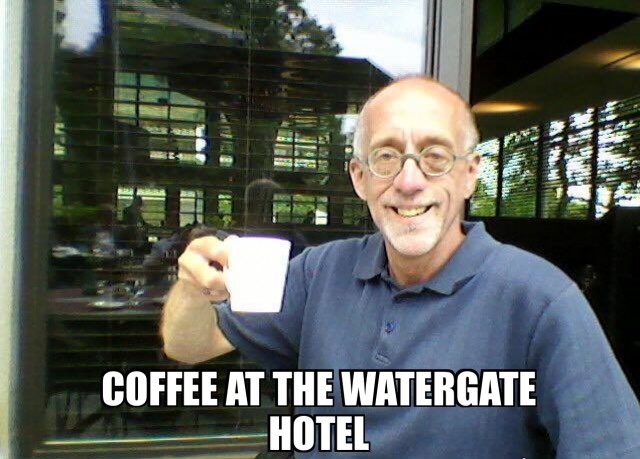

It would be difficult to argue that our nation is not at a pivotal point. It would be difficult to argue that we have not been at such a crisis since the deepest darkest days in 1973 and 1974 when Watergate was searing its way into the minds of a nation that was finally being allowed information and facts about the criminal activity taking place in the executive branch of our federal government.
This weekend I was reading under perfect skies of a late summer day, The Invisible Bridge by Rick Perlstein when I came upon an excerpt from a July 4, 1973 New York Times editorial. The words were meant for the upheaval facing the country during the second term of President Richard Nixon. But they also landed with force given the tense and highly combustible partisanship that we encounter daily.
“…for rarely if ever in the long march of American history —in War or peace, in prosperity or depression—has the nation been so shaken by doubt and uncertainty directly affecting its topmost leadership, its most revered institutions and the very structure of its democratic government”.
I would suspect that the readers of the paper over 50 years ago did not see the words as a rhetorical flourish. Rather, I suspect the readers who cared about the larger issues of the day found the gravity of the editorial as a reckoning of sorts. After reading it, the powerful words of the past land with almost prophetic accuracy about where we find ourselves eight months into Donald Trump’s second term in the Oval Office. One of the segues between that time and our own is that lies from the top leader in the land have a most corrosive impact.
In 1974, New jersey Congressman Hamilton Fish received a letter from a constituent who wrote, “Is Mr. Nixon utterly amoral? Or does he know the difference between right and wrong, but firmly believes that a lie repeated often enough and loudly enough can fool all of the people all of the time?”
Trump’s ongoing trouble with telling the truth or embracing facts means that policy and political lies can have a significant impact on public opinion, particularly with those who are favorably disposed toward him. We know from his first term and now much evidence from his second that not being truthful is a tactic he employs. We also know from the study of political science that once the electorate who supports a person is loaded with misinformation it becomes darn near impossible to change perceptions through credible corrections. In fact, as studies show, attempted corrections often reinforce the initial misinformation. So, when it is a designed tactic for a leader to lie to the public, and at the same time undermine the working press so to destroy the credibly of journalists in factually informing citizens, it is most clear our democracy is in a dangerous mess.
Th editorial in the Times in 1973 was printed at a time when Americans were forced to confront the very real possibility that their highest office had been compromised by its own occupant. The lesson from history about those years is that in order for democracy to survive it must be self-correcting.
Our nation now finds itself shaken. The past week has been gut-wrenching from not only deadly political violence but a tortured and simply weird over-reach of reaction to it. At the center of the reaction is Trump, a flawed political figure who has openly challenged the legitimacy of elections, undermined the judiciary, and cast the press as enemies of the people. The more that we see the reaction of the death of Charlie Kirk the more we see legitimate fears that democratic norms are no longer guardrails but in Trump ‘s world and those of too many of his MAGA base mere optional guidelines. Once again this past week, we see that the language of law from the Oval Office to the Justice Department is bent toward loyalty. From Inauguration Day to the present, the machinery of Trump’s government has been repurposed for personal vendettas.
I well understand that many of my readers will see this as a partisan lament. But those readers who know me understand it is far more. I use this column as a civic shoutout. If we are to survive as a democracy we simply must push back and stem the erosion of shared truth. When facts become negotiable and institutions become stage props, democracy becomes a performative national joke. The stuff that writes itself for a late-night comedian to use.
In 1973, the editorial linked above ended with a call to conscience. Let us recall that democracy is not inherited. (How did so many people forget?) It needs to be enacted in our lives each and every day. I have this small voice on what I still like to call the internet highway where I try to defend the truth to the limits of my writing ability. I also refuse to let the fears being unleashed in this land become a part of Caffeinated Politics.

 Caffeinated Politics
Leave a comment