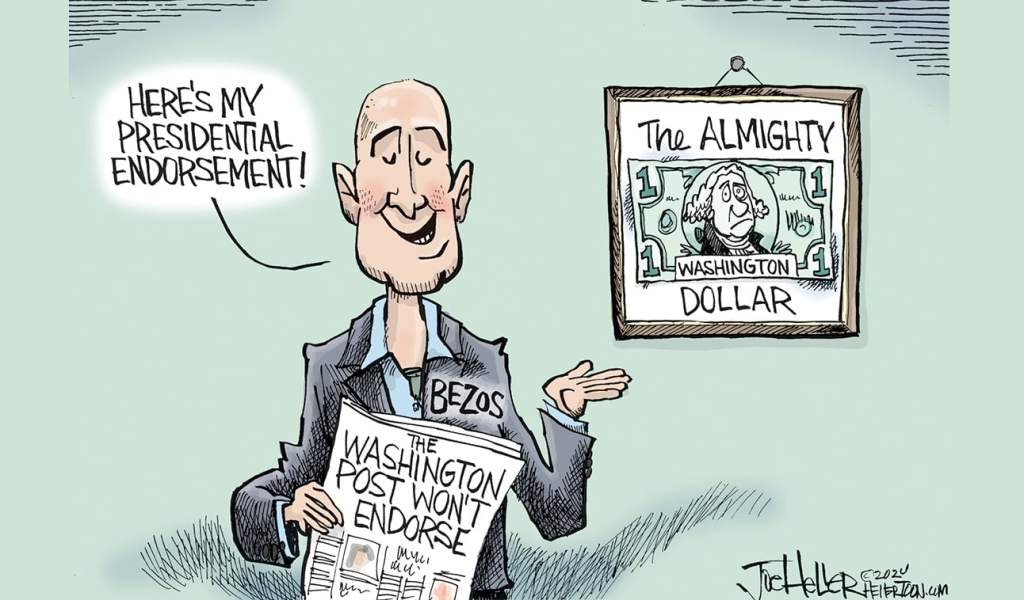
Is Richard Nixon’s revenge finally being realized at The Washington Post? Politicos can debate that, but one thing seems beyond dispute: Jeff Bezos has been the worst thing to happen to that once‑grand newspaper. The decline has become so stark that Michael Calderone now writes that Bezos has gone “from Washington Post savior to executioner.”
This week, the Post laid off roughly 300 of its approximately 800 journalists. There is no satisfaction in seeing such a grim economic measure undertaken by a national daily paper. At a moment when we need more rigorous journalism and deeper reporting, the shrinkage of the Post is a loss for everyone.
It has been nearly a year since I called the Post and canceled our home subscription. My best friend in Minnesota had done the same a few months earlier. We simply could not fathom how the paper had allowed partisan considerations to override its journalistic standards during the pivotal 2024 presidential election. The editorial page had been effectively neutered. Canceling wasn’t a decision I took lightly.
I’ve been a newspaper reader since the 1970s. Growing up in rural Hancock, I read The Stevens Point Journal each day when it arrived in the mailbox. I subscribed to a daily paper while working in Sturgeon Bay and throughout decades of living in Madison. In that sense, I am a newspaperman at heart. So the news from the Post this week feels like a gut punch.
I remain dumbfounded by Bezos’s rash treatment of one of the nation’s most important dailies. He has undermined high journalistic standards and the basic freedom of the press. He shattered any pretense of maintaining independence between his personal political impulses and the needs of a credible newsroom and editorial page. Hours before I canceled my subscription, he restricted the topics that could be addressed on the Post’s opinion pages. He decreed that defending personal liberties and the free market would be the paper’s mission. The rich, wide‑ranging legacy of the Post’s opinion section was being discarded. That same day, opinion editor David Shipley resigned—a completely understandable decision. No journalist could remain credible after such interference from the paper’s owner.
At the time, I wrote the following:
Let me be very honest.
Knowing the owner of one of the nation’s leading newspapers has decided to suckle Donald Trump’s flabby teat, and in so doing, retreat from what has long been a forthright and stellar example of newspaper journalism in the United States, is not what I expect or can accept. After the astronauts, my heroes in high school were Bob Woodward and Carl Bernstein of The Washington Post. I saved up my money to buy All The President’s Men when it was first published. That copy is over my shoulders on a bookshelf as I write. The bravery of Washington Post publisher Katharine Graham as she stood up against the powers of the Nixon White House and positioned herself with the right to inform readers about the Pentagon Papers is a classic example of how professional journalists and news operations function in a democracy.
Jeff Bezos is the opposite.
Throughout my life, newspapers have given me a clearer view of the world and a deeper understanding of government. When Donald Trump took office in January 2017, my family subscribed digitally to the Post because we believed that having strong reporting and context was essential.
“Democracy Dies in Darkness.”
For years, that banner captured exactly how I viewed the role of journalists in our democracy—a role, I would argue, more important than the military. I tried to remain a subscriber because newspapers matter profoundly to the nation. I gritted my teeth for months as Bezos undermined the Post. Eventually, I simply couldn’t justify it anymore.
This week, as more grim news befalls the paper, I’m reminded of the words of Marty Baron, Bezos’s predecessor:
“Bezos argues for personal liberties. But his news organization now will forbid views other than his own in its opinion section. There is no doubt in my mind that he is doing this out of fear of the consequences for his other business interests.”
Sad, prescient words.

 Caffeinated Politics
Leave a comment