
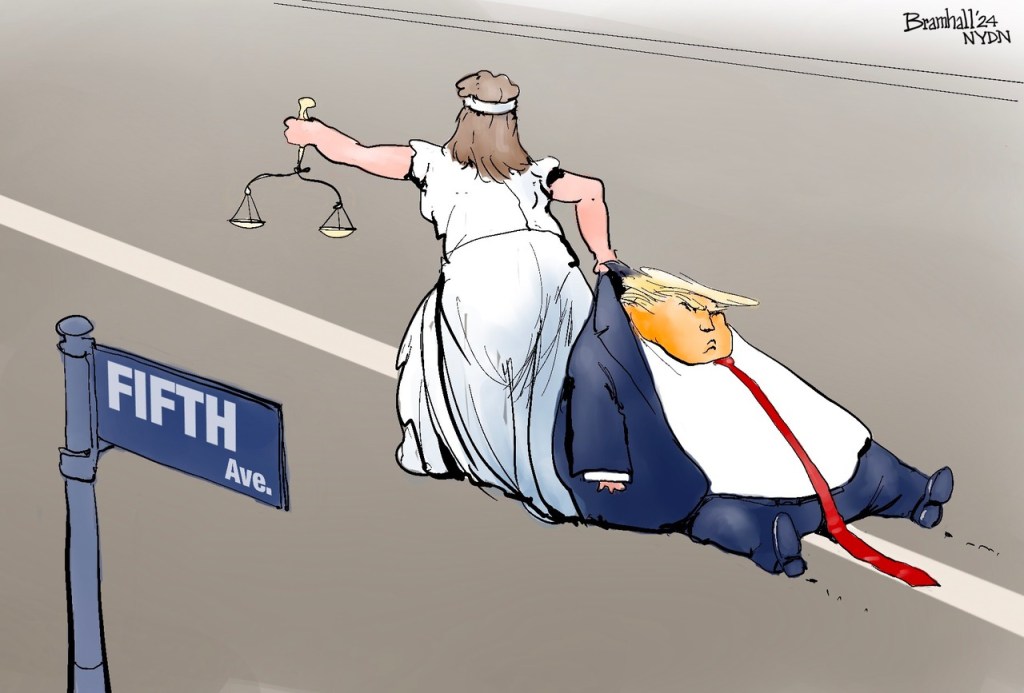
Donald Trump views the Justice Department as his department of personal lawyers. (They are not any president’s lawyers.) He was outraged when he could not control Jeff Sessions, his attorney general, in 2017. Today, Trump filled his diaper to the brim on national television as he berated and trashed the Supreme Court. It was his most embarrassing public display, outside of his inciting a riot on January 6, 2021. Trump is unaware that the Supreme Court justices are independent legal thinkers appointed for their expertise on the law and are, at times, needed to place a constitutional check on executive overreach. Such as the 6-3 ruling against his illegal tariff policy, a function the executive branch does not have the right to make. In ruling against Trump, he called into question their loyalty.
I wrote on this ruling earlier today, but I want to add a short column on the matter of loyalty being owed to a president, and why that is so dangerous to hear coming from a person who sits in the Oval Office.
In 2017, I wrote, like scores of others who blogged or wrote commentary, that the Department of Justice is not, and has never been, the personal law firm of any president. Its mandate is to serve the Constitution and the public interest, not the political or legal needs of a single individual. In 2025, we all needed to reassert the Civics 101 arguments we made in Trump’s first term. To demand personal loyalty from federal prosecutors is to demand the corrosion of the rule of law itself. The Justice Department’s legitimacy depends on its independence; once that independence is surrendered, justice becomes nothing more than a weapon for the powerful. That is the very danger the nation’s legal architecture was built to prevent.
The Supreme Court, likewise, is not a loyalty brigade for any president. It is a coequal branch of government with a constitutional duty that towers above personal allegiance. Its justices swear an oath to the Constitution, not to the occupant of the Oval Office. When a president suggests that the Court owes him loyalty—or that a ruling is “disloyal”—he is not merely complaining about a decision. He is attacking the very premise of judicial independence. That expectation of personal fealty is incompatible with a functioning constitutional republic.
To frame a lawful ruling on tariffs as an act of betrayal is not just inappropriate; it is dangerous. It signals a belief that the judiciary exists to validate the president’s preferences rather than interpret the law. Or to stand on the solid ground of the Constitution. That mindset is unprecedented in its disregard for the separation of powers. It attempts to recast constitutional checks as personal affronts. A president is free to disagree with the Court, but to demand loyalty from it is to demand the collapse of the system that restrains executive power.
Trump’s actions today are why we know him to be a cheap thug with a desire for autocratic power.
The loyalty rhetoric is unconscionable because it strikes at the heart of what keeps American democracy intact. Courts are not instruments of presidential will. They are the safeguard against it. When a president characterizes judicial independence as disloyalty, he is not defending the Constitution—he is undermining it. That is why such statements cannot be normalized, minimized, or accepted. They represent a fundamental misunderstanding of the role of the judiciary and a profound threat to the balance of power that protects every American’s rights.

 Caffeinated Politics
Leave a comment