
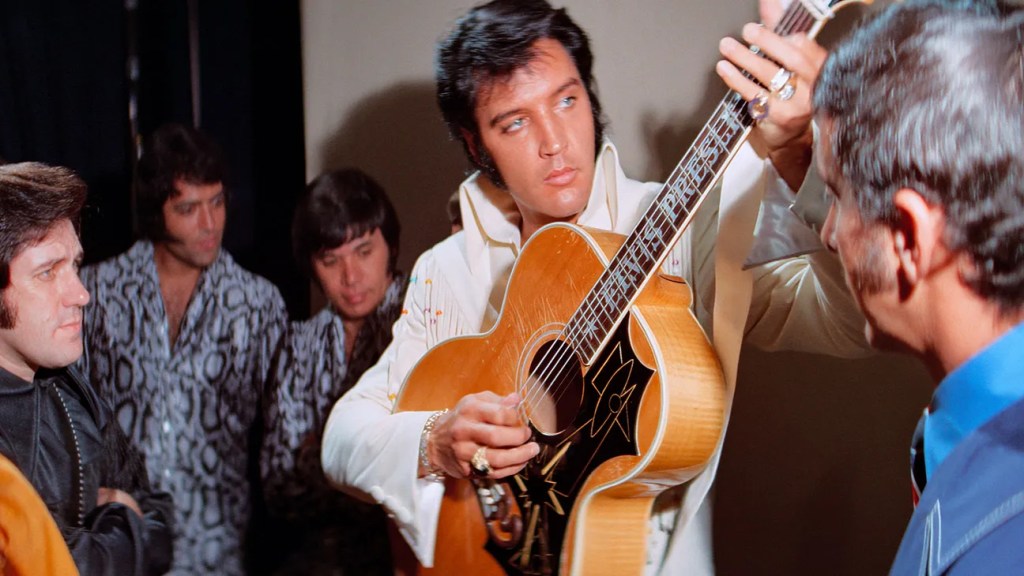
I was not sure what headline to give this column. I had come up with a few.
Elvis Was Always Too Big For Small Screens
A Giant Returns To The Giant Screen
Elvis: Forget The Jumpsuit Stereotype
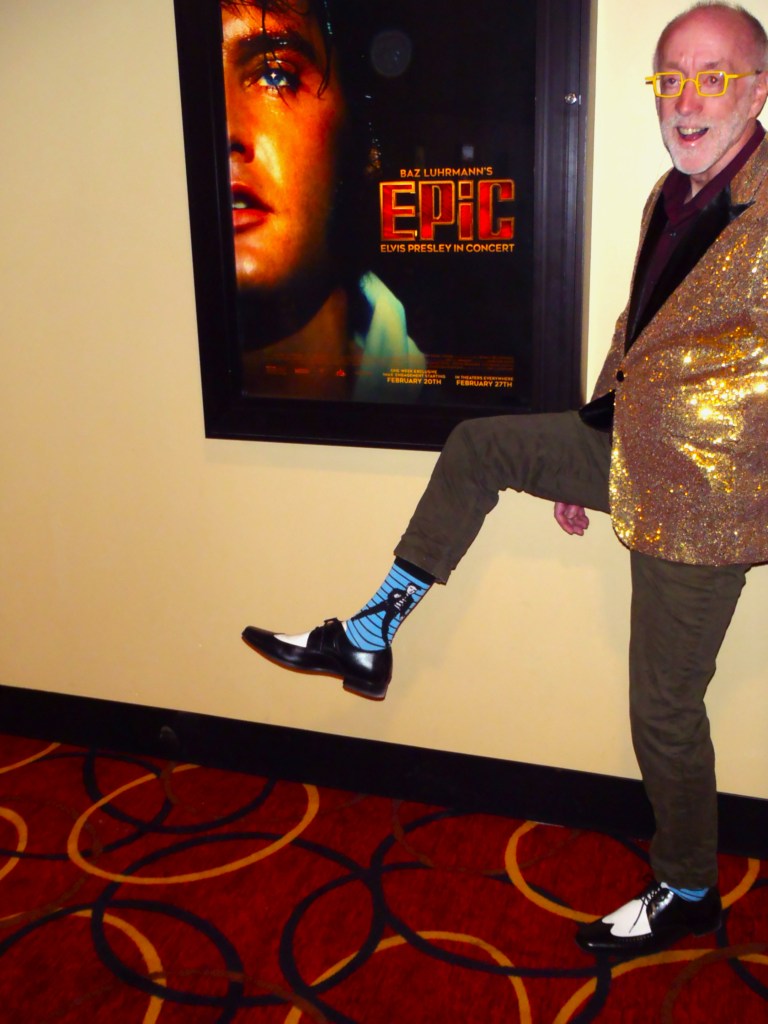
That last idea was on my mind as James, my husband, even after 25 years of being the other half of my life, still doesn’t grasp the enormity and the entirety of Elvis Presley. I am not sure what that says about my teaching style. Perhaps he is not the perfect student. As such, I was glad to sit alongside him for EPiC: Elvis Presley in Concert on the IMAX screen in Fitchburg this evening. Decades-long friend Bruce Miller secured the tickets. Having him as part of the event was perfect, since our musical discussions had never really stopped since we met at broadcasting school in 1981. His reverence for the Beatles echoes mine for Elvis.
So, where do I start?
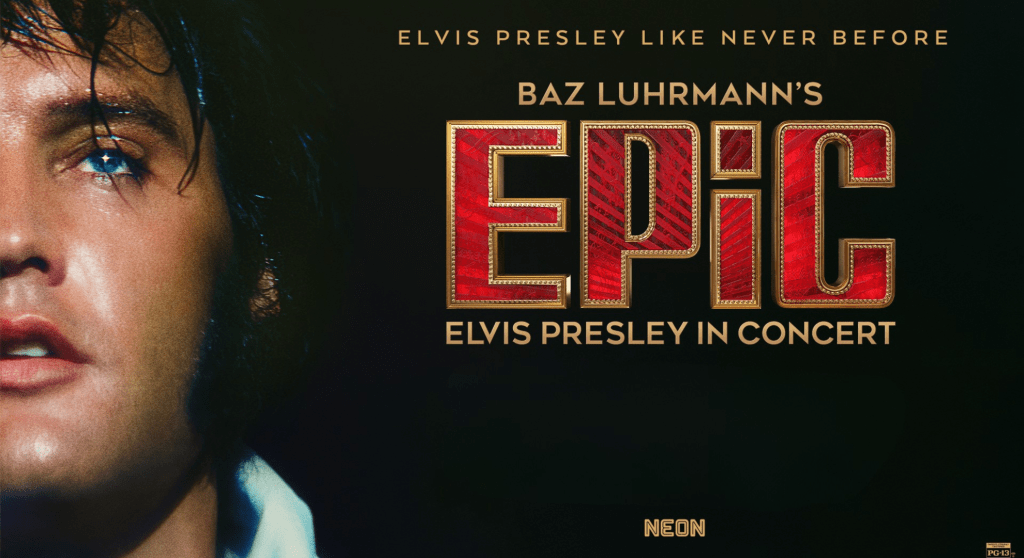
When I first learned about this project a couple of years ago, I must admit hesitancy on my part, as no one needed a knockoff project that was merely a shadow of Austin Butler’s brilliant performance in Baz Luhrmann’s biographical drama, Elvis. If a new project was underway, it had to be powerful. It needed to make a statement about Elvis. What I witnessed, and in equal parts what I heard as the audio in the theatre, makes for an almost religious experience, was of such weight and gravitas that it pushed me back in my seat at times. It was stupendous. It was loud. It left no mistake; the King of Rock and Roll was in the house.
Baz Luhrmann scored again!
There is something almost poetic about seeing Elvis Presley return to the screen, not just any screen, but an IMAX screen large enough to hold the magnitude of a man who reshaped American culture. For long-time fans, such as myself, starting in 1974, this documentary felt like a long‑awaited homecoming, a chance to see the King restored to the scale he has always had in our hearts and minds. But what about the newer generations who are often jaded about parts of our culture they are not aware of or should be more connected to?
Over perhaps the past decade, from conversations and observations, it seems that Elvis has been reduced in the modern imagination to a jumpsuit, a caricature, a Vegas punchline. I cringed (and even wrote Joe Scarborough notes) for referring to Donald Trump and “Fat Elvis” in the same sentence, for continuously playing their long-ago greatest hits. (One about white male grievances and the other about the hits from the 1950s.) But this film briskly sweeps away the dust of parody and reintroduces Elvis as the cultural earthquake he truly was. Watching him tower over an IMAX theater, I certainly felt the magnitude again. With the film in worldwide release, I suspect what many knew instinctively about Elvis is having a rebirth.
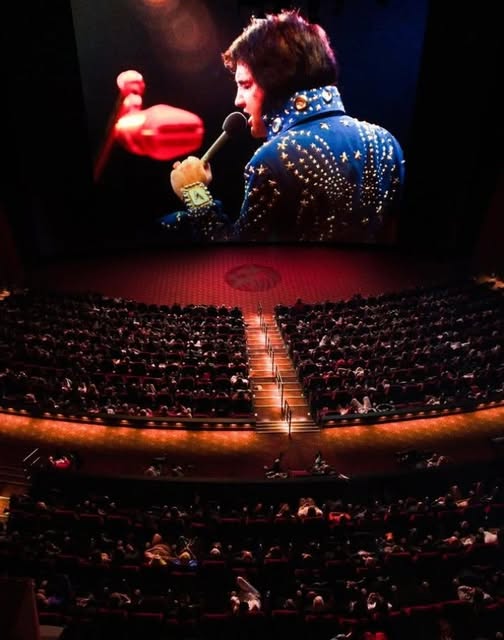
I had joked that my seat in the theatre should have a seatbelt. That was not a bad suggestion, as for me, the film was like a raw, continuous bolt of electricity. For someone reading this column and wondering if they should see the film, let me put it this way. You are not in the audience watching Elvis. You are on stage with Elvis as he performs. There is a close connection and urgency to the film and the music. You are close to the obvious charisma, but also his vulnerability, which is an aspect of the man that connected with me as a teenager. When facing my own battles in those years, it was his experiences that showed me how to live authentically. A lesson for a lifetime.
It was a most compelling part of the film to hear Elvis talk about music and life in soft, subdued tones and know the man off the stage. Then, in split-second timing, the band is live and loud, and Elvis is taking command of the stage. It was the duality and how it was presented that put the two halves of his life together as much as split them apart. The editing of this film was like splitting a cell. Timing in less than a second. Masterful.
If you ever wondered, as James claims, why people screamed, fainted, and swore they’d never be the same after seeing him perform in concert, this film will answer your questions. Elvis fans have always known that he wasn’t just talented. He was transformative. He didn’t just sing songs; he rearranged the cultural DNA of an entire nation. Sideburns and a pink jacket in the 1950s did not just make a statement. It helped to create a revolution. Seeing him on the IMAX screen, with every bead of sweat and every flash of that crooked smile magnified to mythic proportions, reminds us why he became a phenomenon that no one could contain. And why people screamed for more of the same.
At moments in the film, when I thought about it at ‘30,000 feet’, I could sense its impact on the curious theatergoer who will see this film across the world. Some will see it for the cinematic experience. Perhaps they will be curious, skeptical, and younger. (Whatever that means.) Perhaps they will be from generations who knew Elvis only as a Halloween costume or a meme. Many people today have inherited the caricature, I have discovered from conversations, but know very little about the man. They know the jumpsuits, not the revolution. This documentary is, and I am glad to be writing this evening, the antidote to that misunderstanding.
The film brilliantly shows the raw, revolutionary Elvis. The one who fused Black gospel, blues, and country into something America had never heard before delivered in this fashion. The one who challenged social norms simply by existing. The one who made teenagers feel alive and made their parents panic. The one who, before the rhinestones and the Vegas residency, was a cultural lightning strike. If you walk into the theater thinking Elvis is just a cheesy relic, you walk out realizing he was a seismic force whose influence still reverberates.
One of the reasons I loved Elvis as a teenager in the 1970s was knowing he didn’t politely enter the music scene. He saw the door and knocked, and when it was slammed in his face, he simply detonated it. His arrival marked a turning point in American culture, and the documentary captures that sense of upheaval. He broke racial barriers by bringing Black musical traditions into the mainstream at a time when segregation was still the law of the land. He redefined masculinity, blending toughness with tenderness, rebellion with vulnerability, sexuality with sincerity. As a gay teenager who was finding a path, he was a much-needed teacher.
He ignited youth culture, giving teenagers a soundtrack and an identity at a moment when America was on the cusp of enormous social change. He reshaped entertainment, influencing everyone from The Beatles to Beyoncé, from Bruce Springsteen to Bruno Mars. His impact wasn’t subtle. It was sweeping, controversial, exhilarating.
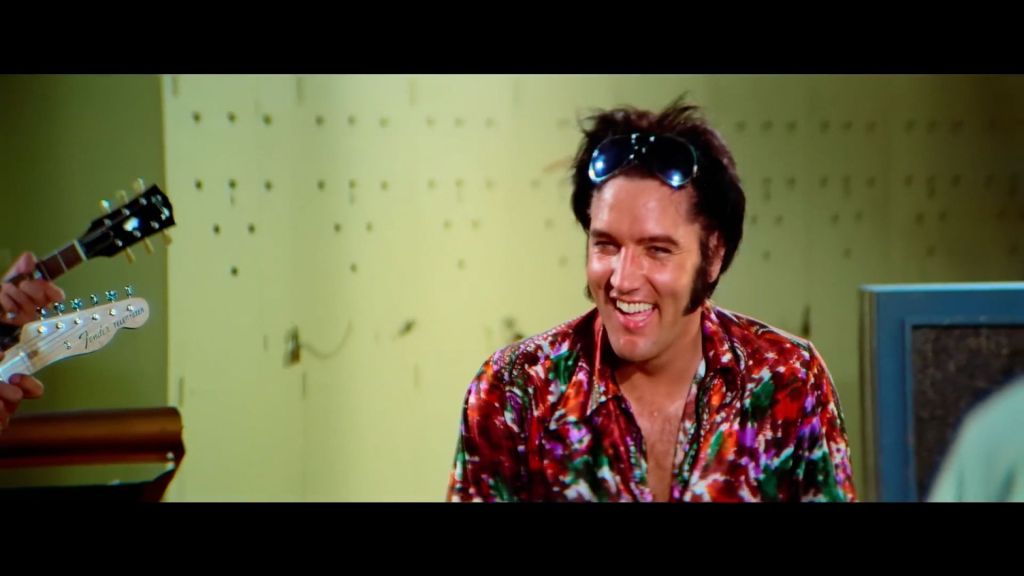
IMAX matters here because Elvis was always too big for small screens. He was born for spectacle, not because he was flashy or ego-driven, but because he radiated a kind of emotional intensity that filled whatever space he occupied. (I suggest paying attention to how he moves with almost kinetic energy even in rehearsal sessions.) The IMAX format finally gives him the scale he deserves. You see the way he moves—not as a joke or a caricature, but as a man who understood rhythm in his bones. You hear the voice—not as nostalgia, but as a living, breathing force. You feel the crowd—not as history, but as human electricity. The every electrity felt in the IMAX theatre. The documentary becomes more than a film. It becomes an encounter, a reminder that Elvis was not just a performer but an experience.
I thought of a line from a Greil Marcus book (Mystery Train?) during the film. “It is said that America gave three things to the world: Mickey Mouse, Coca-Cola, and Elvis Presley. And only one of them is human.” Older people connect with that sentiment. For them, this film was a love letter of sorts. For newcomers, it is an awakening, a chance to understand why Elvis mattered and why he still does. It is rare for a film to honor a legacy while also rewriting it for a new era, but this one manages to do both with grace and power. Baz Luhrmann directed a film that bridges generations, inviting everyone—whether they grew up with Elvis or only know him through pop‑culture shorthand—to witness the phenomenon for themselves.
Even now, nearly fifty years after his passing, Elvis remains woven into the fabric of American culture. You feel him in every artist who blends genres, pushes boundaries, or dares to be unapologetically themselves. Walking out of the IMAX theater, I felt like I had not watched a documentary, but rather witnessed a force of nature. The film was that BIG. As I left the theatre, I thought Elvis was never meant to be confined to grainy footage or cultural clichés. He was meant to be experienced. And this film gives us that experience. Elvis didn’t just change music. He changed America.
(After finishing this column about Elvis Presley, I need to state how much I enjoyed working on it. I am glad to have a blogging site where space is not limited. One day, there will be a troubling headline from Washington that requires a response, and the next, I can opine on the emotions and views following an IMAX blockbuster experience. Thanks for reading my perspectives.)


 Caffeinated Politics
Leave a comment