
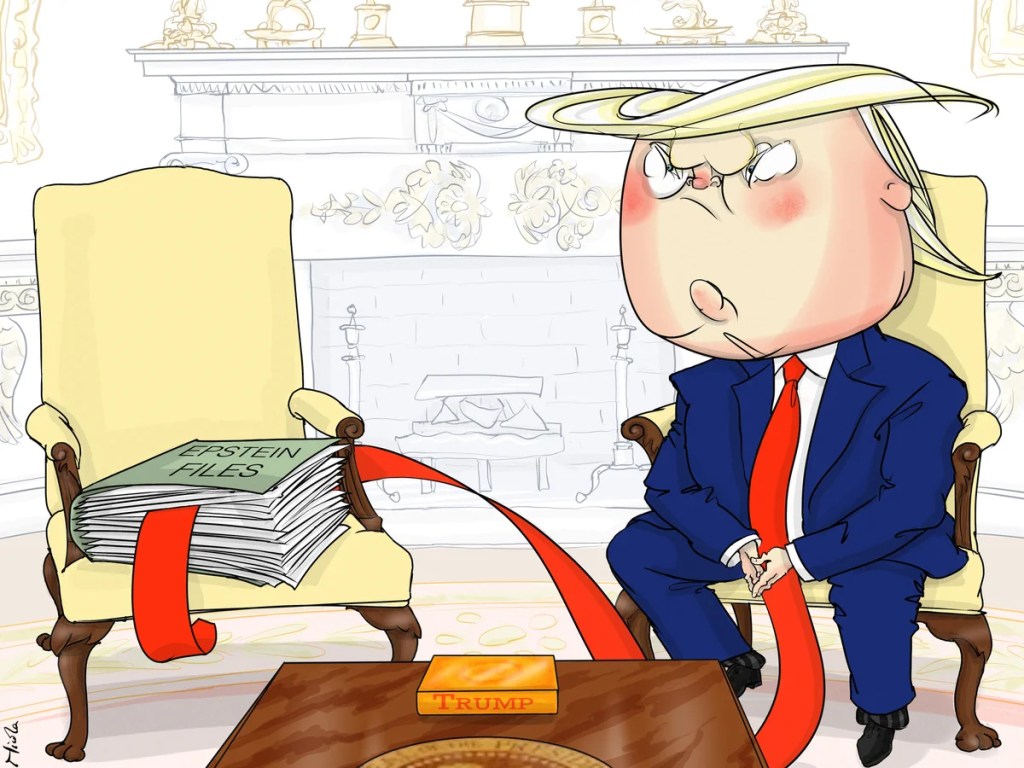
When leaving a restaurant on Tuesday evening, I passed the bar and asked a man drinking a beer if he was taking a swallow for every lie Donald Trump uttered in his SOTU address. “Do you have any idea how many bottles I would need?” The moronic behavior and the raft of lies and mathematical impossibilities were simply the latest embarrassments Trump sprayed all over the nation. By the time the sun came up the next morning, however, the country was talking about a then-13-year-old girl who said she was sexually assaulted by Donald Trump. The Justice Department failed to include the files about this matter in its Jeffrey Epstein dump weeks ago. The materials are F.B.I. memos summarizing interviews the bureau conducted in connection with the sexual abuse claims made in 2019.
I can hear the man at the bar saying, “No mention of this in the SOTU speech.”
Today, I strongly suspect his eyes would roll as he said in a fake, stunned tone, “It is unclear why the materials are missing.”
Unclear, indeed.
All of America is surely shocked, shocked, I say, to again face the fact that Trump is a sexual predator. He was recorded saying he could just walk up to a woman and grab her between the legs. New York Judge Lewis A. Kaplan stated that when E. Jean Carroll repeated her allegation that Trump raped her, her words were “substantially true.” Rape allegations are not new when it comes to Trump. At least 28 women have accused Trump of various acts of sexual misconduct, such as assault, kissing and groping without consent, looking under women’s skirts, and walking in on naked pageant contestants.
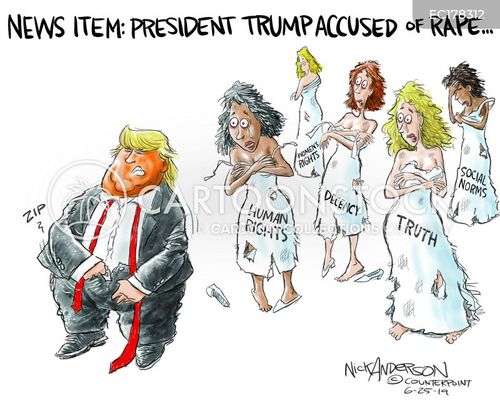
As I evaluate Trump’s life, what strikes me, in addition to the resolved cases and the long list of criminal allegations, is his long history of insulting and belittling women when speaking to the media. His lewd comments about women, disparaging their physical appearance, and referring to them using derogatory epithets, as he did just a few months ago on Air Force One, underscore his profile as a predator. There is a lot of evidence about Trump’s overt anger toward women.
With reporting from NPR about the missing files, the Trump-Epstein headlines are naturally erupting. That teenage girl, now a woman and a survivor, accused Trump of heinous crimes, and we are to believe the files were ‘misplaced’.
I have two very strong problems with what is now happening. First, the criminal behavior of the person now sitting in the Oval Office. Even before this week’s news, Trump is a convicted felon, of 34 charges. Second, what does all this do to the body politic and the fraying trust in our national institutions?
I should not need to write it in this column, or any column, but no one is above the law, not even the president. When allegations of serious misconduct, especially those involving minors, intersect with the machinery of federal power, the public’s trust is not merely strained; it is much endangered. This controversy surrounding the handling of sealed or partially released Epstein‑related files has become a flashpoint, leaving critical questions unanswered and fueling the perception of selective disclosure.
We have never had to deal with a president implicated—directly or indirectly—in allegations of underage criminal sexual misconduct. Was it oral sex with a minor? Rape akin to what happened to E. Jean Carroll? Just one more disgusting outcome this nation needs to wade through in the months ahead, due to the low-IQ white voters in 2024 who clearly self-defined themselves. What those anti-Mensa voters are not pondering today is that the executive branch is influencing and obstructing the release of information that the public has a right to see.
For the rest of the nation, we are repulsed by the idea that a president might use the Justice Department as a shield rather than a guardian of accountability. That is intolerable.
The alleged crimes at the center of this controversy are among the most serious imaginable. Sexual exploitation of minors is not a political issue; it is a moral one. If a president has engaged in such acts, the gravity of that wrongdoing eclipses even the most egregious institutional failures. Yet the failures still matter. A cover‑up, whether through omission, delay, or manipulation, compounds the harm by denying victims the transparency they were promised and the public the truth it deserves.
The Justice Department’s role is not to protect the president but to uphold the law impartially. When it appears to do otherwise, the damage extends far beyond one case or one administration. It erodes confidence in the very institutions meant to safeguard democracy. It tells these women that their courage may be met not with justice, but with silence.
The American people were told these files would be released. They were told the truth would come out. That commitment must be honored fully, not selectively. Anything less invites the suspicion that political interests in the Trump White House have overridden legal and ethical obligations.
If the allegations against Donald Trump are true, the crimes themselves are horrific. But the possibility of a coordinated effort to obscure them—using the authority of the federal government—would represent a systemic betrayal. Transparency is not optional. Accountability is not negotiable. And justice delayed, especially in matters involving children, is justice denied.

 Caffeinated Politics
Leave a comment