
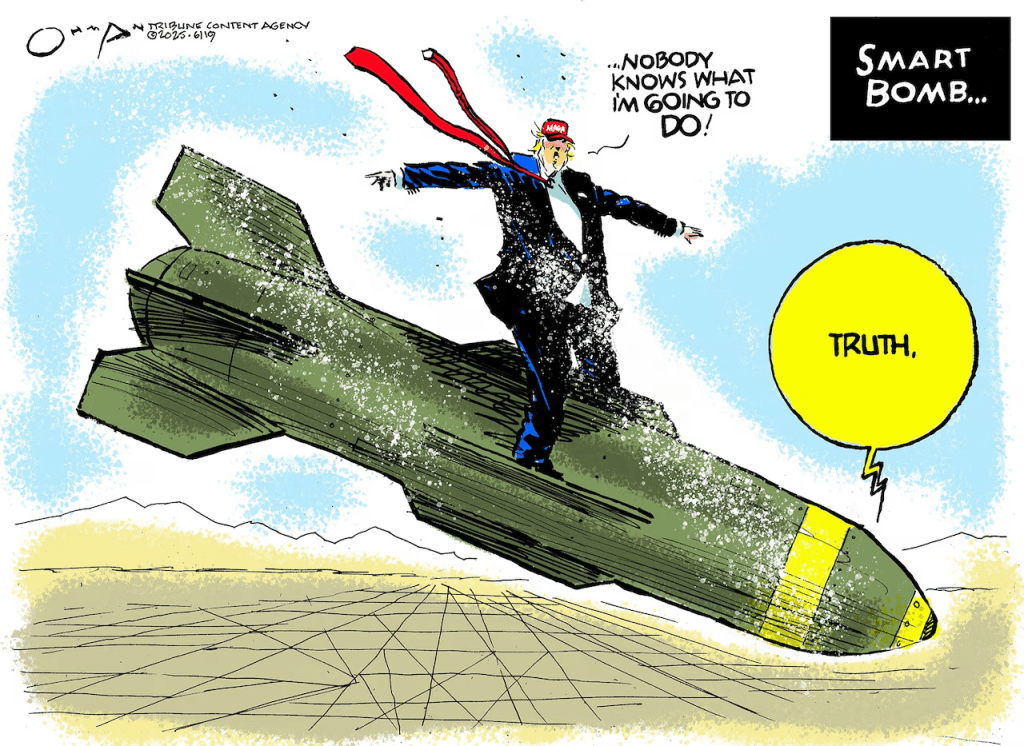
Congress’s abdication of its constitutional responsibilities has rarely been as conspicuous as in the recent escalation toward armed conflict with Iran. The War Powers Clause was designed as a deliberate constraint, a structural safeguard meant to prevent unilateral martial adventurism by any president. Yet the latest round of strikes—undertaken without deliberation, authorization, or even meaningful consultation—illustrates how thoroughly that safeguard has atrophied. The constitutional architecture presumes a legislature willing to assert its prerogatives. What we have instead is a Congress so politically timorous that it has allowed the executive to accumulate a de facto monopoly over decisions of war and peace.
The strikes themselves, carried out without a congressional mandate, exemplify the erosion of the separation of powers. Many legal scholars argue that such actions fall outside the boundaries of constitutional legitimacy because they bypass the explicit requirement that Congress authorize sustained hostilities. The framers did not intend for military force to be deployed at the discretion of a single individual, particularly in circumstances that risk spiraling into a broader regional conflagration. When Congress declines to debate or vote on these matters, it is not merely avoiding political discomfort; it is relinquishing one of its most solemn duties.
This pattern of legislative reticence is not new. Over the past several years, Congress has repeatedly hesitated to confront the excessive lawlessness and dangerous absurdity from Trump’s executive branch on a wide array of issues, from oversight disputes to illegal emergency declarations. That hesitancy has now metastasized into something more dangerous: a willingness to allow the president to initiate hostilities without democratic scrutiny. The result is a political environment in which the executive can act with near-impunity, while the branch constitutionally empowered to check such actions remains conspicuously silent.
The consequences of this institutional inertia are profound. When Congress fails to assert its authority, it not only weakens its own institutional standing but also distorts the balance of power envisioned by the Constitution. Decisions of war—decisions that carry immense human, financial, and geopolitical consequences—should not be made through executive fiat. They require deliberation, debate, and democratic legitimacy. Without those elements, the nation risks entering conflicts without clarity of purpose, without public consensus, and without the constitutional grounding that gives such actions moral and legal weight.
The deeper tragedy is that this moment could have been an opportunity for Congress to reassert its constitutional role. Instead, by declining to debate or authorize the strikes, it has signaled once again that it is unwilling to confront the executive, even when the stakes involve the gravest powers the government possesses. The result is that war can be initiated not through collective judgment but through unilateral decision, and the outcome, as Joseph Ellis reminds us, that the framers explicitly sought to prevent.
Trump’s unilateral military actions toward Iran, described by many commentators as constitutionally dubious because they bypass the deliberative authority the Constitution assigns to Congress, have illuminated a deeper institutional failure. The seriously undereducated and mentally impaired (STD reaching Trump’s brain?) is being allowed to wield the gravest powers of the state without meaningful scrutiny. The necessary blowback, rooted in civic insistence, congressional reassertion, and a renewed commitment to constitutional equilibrium, must come from both Congress and the American people, who together bear the responsibility of ensuring that no president, regardless of party, can unilaterally propel the nation into conflict without the legitimacy that only democratic deliberation can confer.
This disease-ridden gibbon monkey must be stopped by Congress.

 Caffeinated Politics
Leave a comment