
I woke up today with news reports that Sturgeon Bay, Wisconsin, received 33 inches of snow from this weekend’s blizzard. That is not a typo. One’s mental jaw drops. All of a sudden, the snowblower work at our home in Madison did not seem daunting at all. I thought, after hearing the news of the powerful winter blast, of another storm when I was working at WDOR AM-FM in that city. The small family-run radio station at the corner of 15th and Utah produced many fond memories. The night that I was stranded at the station now is one of them.
It is easy for me to say after decades of experience that there are storms you forget by lunchtime, be it a snow event or a thunderboomer. But then some settle into the collective memory of a town, a county, or a radio announcer. The kind of storm locals still talk about years later, with a half‑laugh and a slow shake of the head. Last night’s blizzard in Sturgeon Bay belongs squarely in the second category. That was a humdinger.
But so was the one in 1985 that stretched all across the thumb of the state and down to Green Bay and sections west. By sundown on that Sunday night, the wind had already begun its long, low howl across the ship canal, rattling porch lights and sending the last few brave souls scurrying home. Within a few hours, the city was swallowed whole. Roads vanished. Plows did not even start working, but workers gave a time the next morning when they would take to the county byways. The county highway map might as well have been erased. But through it all, in that small radio station, the studio lights never dimmed. The county was in a whiteout, but if one could have seen it in the snowy sky, there was a tower with a blinking red light stubbornly refusing to be squelched into the swirling storm.
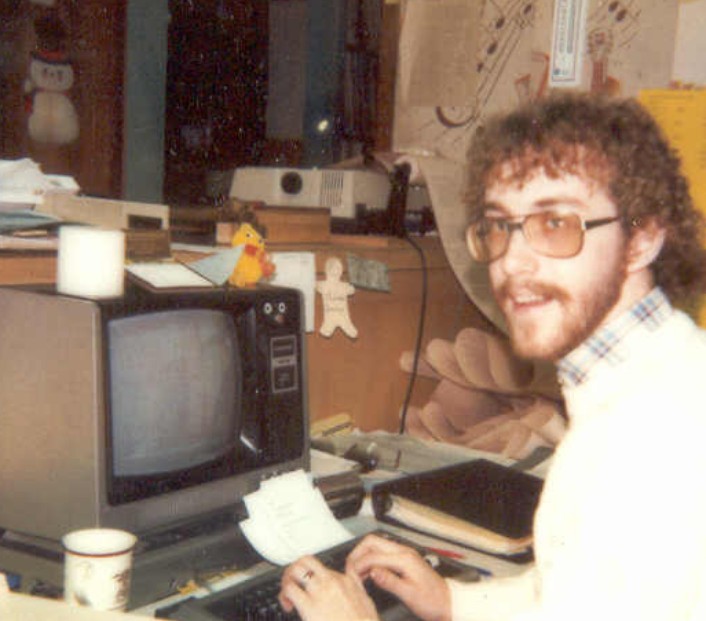
Inside, there was by now a highly caffeinated nighttime radio announcer behind the studio microphone. (When I was at the station, the coffee pot was not only on but the brew was strong. One could enter the front of the building and know a fresh pot was brewing.) With headphones draped over my shoulders, I am sure nothing had been planned that afternoon and evening other than a quiet shift and cups of coffee. But by the time I thought about how I was going to get home, it became crystal clear I was going to be stranded at the station. With reports from law enforcement and city officials and the good-hearted folks from all over the county who gave me calls and insights into what was happening in their area, for better or worse, the station was going to be home for the night.
The station owner called me and said the station should remain on the air until 1:00 A.M. to keep listeners in touch with what they needed to know. By mid-evening, our station had become an on-air message board for all sorts of reports. Let me try to explain.
The listeners who would call into the studio while I was on the air were often faceless characters who provided information and flavor for the listening audience. Here is an example. With the awesome snowstorm bearing down on Door County, there would have been the usual report from the local police about the road conditions, urging caution with the slick streets. I would have listened and yawned as I had heard it many times before, as I thought to myself that the well-intentioned law enforcement official did not provide the type of information I wanted.
Rather, I would wait for the man who called himself ‘the Egg Harbor Reporter to dial me up and give some gripping account of how a car nearly wiped out at the curve where he lived, or how many inches had stacked up on his mailbox. (The Egg Harbor Reporter performed his job earnestly. I can still hear his slow, deadpan delivery of the information he called to share.)
Egg Harbor Reporter: “Hey Trevor, it is coming down mighty heavy right now.”
Me: “It is snowing huge flakes here, too.”
Egg Harbor Reporter: “The dog wanted to go outside, but once I opened the door, he was only interested in being outside for a minute. I can’t blame him. I cannot even see the bird feeder up in the tree; it is blowing so hard. Have the scanner on, and there are lots of slide-offs. Today is when you want to have a wrecker service.”
With that, he would give a hearty chuckle. “Say, what happens if you cannot make it home and have to stay at the station?”
Me: “I call in the military for an airdrop of food!”
Egg Harbor Reporter: “You have any Kenny Rogers handy to play for me?”
Me: “With or without Dolly?”
Egg Harbor Reporter: “Well, everything is better with Dolly.”
Me: “Will do. Let me know if things get really interesting up your way.”
The Egg Harbor Reporter was a clear favorite of mine and often had a song request. I am not sure the man ever slept, as he had a reason to call and chat about the weather every chance he got, and I must say he was highly entertaining. He wasn’t the only one, though. I also loved hearing from the folks who had or had not made it over the ‘Brussels Hill’ in Southern Door County. If they had barely done so, they wanted me to alert others to take another route.
Perhaps the best account of the local streets in Sturgeon Bay came from the lady who, from time to time, delivered a baked good from her oven to me at the station as she went to church. She would pop into the back door of the studio, thank me for the Southern gospel music I played starting at six o’clock in the morning, update me on the streets in winter, and drop off some wonderful sweets. Some people are nice to the person who delivers their morning paper, but she appreciated her local neighborhood radio announcer. She made many of my early Sunday mornings so much more satisfying. She often baked a tart-like, crusty creation that had the four corners brought together with a fruit-filled center and then sprinkled with powdered sugar over the top.
Who doesn’t like sweets? But the fact that she drove to the station to drop them off meant that I was connecting with people over the airwaves. I was not sitting at their table or talking with them over the backyard fence. I was communicating to them and connecting with them on some level that mattered—and all through the radio. The key to broadcasting, I had felt as I listened to my radio friends as a teenager, was making that very real and very personal connection with people. I was able to replicate that with listeners in Door County. That meant a great deal to me.
There’s a particular kind of silence that comes with a wild snowstorm. A thick insulating quiet that makes you feel like the world has paused. After the station had been turned off for the night, I had some books in the car, and the coffee kept being poured as I listened to the winds battering the old windows in that building.
The hour approached for the 5 A.M. sign-on, and then, following the ABC News listeners would have surely heard a hyper-voiced announcer. With every conceivable piece of information one would care to know on a morning like the one dawning on Door County. Thinking I would have made an excellent meteorologist due to my love and fascination with weather, and loving to impart information as an announcer, I was perfectly placed for what radio does best.
When there is a need to know and a pressing issue to be informed about, I know a familiar voice on the radio feels like a lifeline. And in small towns and rural areas, the radio station isn’t just a frequency. It’s a neighbor. A companion. A thread that stitches everyone together when the weather—or life—turns unpredictable.
Of all the media available, radio is the one medium that allows us to truly be close to one another. The ‘intimacy of radio’, as I like to call it, is felt in no greater degree by listeners than when it takes place from a small, locally-owned radio station, with a local neighborhood announcer behind the microphone. While I was on the air, I always thought of myself as just a broadcaster from the neighborhood who tried to inform, entertain, and be companionable.
By dawn, the storm had exhausted itself. The world outside was buried in drifts taller than mailboxes, and the plows were only just beginning their slow crawl out of the municipal garage. That morning, the announcer they heard on WDOR was not bleary‑eyed, but instead one who flipped on the mic and opened the morning with a voice that carried the main message of the day.
“Gooooood morning, Door County. If you’re waking up and wondering whether school is open today… it isn’t. Nothing is.”
I read through a stack of closings so thick it could’ve doubled as a phone book. Schools, shops, clinics, the bait store, the bakery—every corner of the county had called in. Between announcements, I shared road conditions, plow schedules, and the occasional message from a listener who had power but no way to shovel out.
And people listened. They always do. Because in a place like Sturgeon Bay, the radio isn’t background noise. It’s the pulse of the community. It’s how you know whether the bridge is open, whether the fishing derby is still on for that coming weekend, and whether your neighbor down the road needs a hand digging out.
By midmorning, the sun finally broke through, turning the snowbanks into glittering walls of light. I stepped outside for the first time since the night before, blinking at the brightness, breathing in the sharp, clean air. The town was still quiet, still buried, but alive again.
And somewhere, in kitchens and living rooms across the county, people sipped their coffee and felt just a little less alone because someone at WDOR had stayed awake through the storm, keeping watch, keeping company, keeping the signal alive. In small towns, that’s what radio does. It shows up for each other—even when the roads are closed, and the snow is piled high against the back door.
I loved my job. While there are no truly remarkable broadcasts that anyone
will recall from my time at the station, I cherish the countless fond memories that resulted from Eddy Allen, Jr.’s decision to hire me for his broadcasting business. There are now only smiles and warm memories as I look back at those years at WDOR.
My DNA has made me wired to be nostalgic. So when I heard about the blizzard that socked Sturgeon Bay this weekend, it made a column like this essential. Just like at the station, when I gathered up the latest winter storm updates, wrote a news story on a typewriter, and ended it with my ‘outcue’, so too do I end my copy here in the same fashion.
###

 Caffeinated Politics
Leave a comment