
Eric Rauchway’s Murdering McKinley situates the assassination of President William McKinley within a nation deeply divided by the forces of industrial capitalism. I probably did not need to pull another book from the shelves this weekend, but I was in the mood for something different, so the slim volume of just over 200 pages fell easily into my hands and met the need to focus on something new. I can write that this is another slice of historical research that is argued and written in a powerfully convincing fashion.
Historians have often, and correctly in my estimation, understood the depravity of the assassination in 1901 of President William McKinley, while at the same time exclaiming, ‘Look what followed!’ The closing pages of the nineteenth century and the opening of a new book featuring the 20th century are an apt way to view that assassination and its momentous consequences.
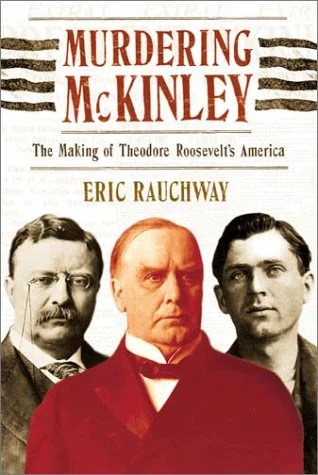
By 1901, the United States had undergone decades of rapid economic transformation that enriched a small elite while leaving millions of workers in precarious, low‑wage, and often dangerous jobs. Rauchway uses this backdrop to show how the widening gap between the wealthy and the working poor shaped the political climate of the era and influenced how Americans interpreted the tragedy. The assassination became a moment when the country’s simmering anxieties about inequality rose sharply to the surface.
Leon Czolgosz, (pronounced CHOL-gosh as the author notes), McKinley’s assassin, emerges in Rauchway’s narrative not as a mysterious outsider but as a figure shaped by the harsh realities of working‑class life. A factory laborer who drifted in and out of employment, Czolgosz was drawn to anarchist critiques of capitalism because they spoke to the alienation and instability he experienced firsthand. Rauchway does not excuse his violence, but he shows how Czolgosz embodied the frustrations of a class that felt increasingly shut out of the prosperity celebrated by political leaders. To many people in power at the time, he represented the dangerous potential of the poor, seen as a symbol of what could happen when economic inequality went unaddressed.
Rauchway also explores how ordinary Americans interpreted the assassination through the lens of class. For the wealthy and middle class, Czolgosz’s act was evidence that radical ideas among the poor posed a threat to social order. Newspapers and public officials quickly framed him as mentally defective or morally corrupt, interpretations that conveniently avoided acknowledging the economic conditions that shaped his life. This pathologizing of the assassin allowed the nation’s powerful to treat the event as an aberration rather than a symptom of deeper structural problems. I found this fascinating, given the number of influential and powerful people who had been assassinated around the globe during this period due to anarchist beliefs. It also fueled calls for stronger policing, surveillance, and suppression of dissent.
The book is dotted with historical nuggets that beg to be discovered. For instance, in 1892, the Republican National Convention was being held in Minneapolis as the weather was exceedingly hot. We find McKinley hoisted on the shoulders of joyous people at his hotel, but he found the situation undignified “as the jostling sent one of his trouser legs creeping up to his knee, laying bare his leg and stocking garter.”
But the gems of nuggets keep coming as we soon find McKinley and his political guru, Mark Hanna, along with a Chicago newspaper owner, Herman Kohlsaat, all stripped to their underwear, cooling off on the bed in a hot hotel room. One photo. History only asks for one photo. That type of intriguing information is found throughout this magnificent short book.
Working‑class Americans condemned the assassination but recognized the desperation behind it. Many saw the widening divide between rich and poor as unsustainable and feared that the killing would be used to justify crackdowns on labor movements and immigrant communities. Rauchway shows how these fears were not unfounded: the political response to the assassination often focused on controlling unrest rather than addressing the root causes of inequality. In this sense, the public reaction revealed a society struggling to understand itself at a moment when class divisions were becoming impossible to ignore.
The transition to Theodore Roosevelt’s energized presidency further highlights the era’s class tensions. Roosevelt presented himself as a reformer willing to challenge corporate power, but Rauchway emphasizes that his approach was also about stabilizing a social order strained by inequality. His rhetoric acknowledged the grievances of the working class while ultimately reinforcing the authority of the state and the legitimacy of the economic system. McKinley’s assassination thus becomes a turning point that accelerated the shift toward a necessarily more interventionist government. Even then, the changes delivered sought to manage class conflict rather than resolve it.
Through this lens, Murdering McKinley, Rauchway’s analysis reveals a country eager to explain violence without truly confronting the structural injustices that produced it, and in doing so, he offers a powerful commentary on how societies respond to inequality and unrest.
For a book I pulled off the shelves on a whim, it was a thought-provoking and immensely interesting read. Five stars out of four. Really.

 Caffeinated Politics
Leave a comment