

On Tuesday, Wisconsin voters will cast ballots for a variety of candidates and referenda on the Spring Ballot. But the statewide race for the selection of the next justice for the Supreme Court should not be one of the decisions voters are asked to make. For nearly 30 years, I have advocated for the merit selection process for selecting justices on the high court.
Along with just about everyone else in our state, I respect and enjoy listening to Charles Franklin as he breaks down the polling data from Marquette Law School. It is fascinating to read the results and have the wisdom of Franklin voiced as he delves into what the voters are saying. But I do wonder what the voters feel about a deeper issue than who will sit on the court this August. Given how saturated the political and partisan nature of the court races has become, is there a growing mood to change how justices are placed on the bench? I would love Franklin to poll a series of questions in this regard and then listen to him expound on the results. I believe, based on random conversations, that the perceived politicization of the court is causing concern about the objectivity of the court.
I have argued that merit selection would be a more reasonable and logical method of choosing those who interpret and uphold the law. While judicial elections may appear democratic on the surface, they often undermine the very qualities that courts must embody: independence and impartiality without an erosion of the required public trust.
Former U.S. Supreme Court Justice Sandra Day O’Connor spent years warning that the American experiment with judicial elections was drifting into dangerous territory. She famously said, “No other nation in the world does it the way we do, with judicial elections. And I think we’ve made a mistake.” Her point was clear. Judges should not be forced to behave like politicians, nor should justice ever appear to be influenced by campaign money or partisan pressure.
Merit selection can vary in how it operates, but overall, a nonpartisan commission evaluates applicants, interviews them, and recommends the most qualified candidates to the governor. After serving for a period of time, the judge faces a simple retention election in which voters decide whether to keep them on the bench. This approach prioritizes legal ability, temperament, and experience rather than fundraising networks or political charisma. It ensures that judges are chosen for their qualifications, not their campaign skills, and that they remain accountable without being pulled into the machinery of electoral politics.
Many states have adopted some form of merit selection for at least part of their judiciary
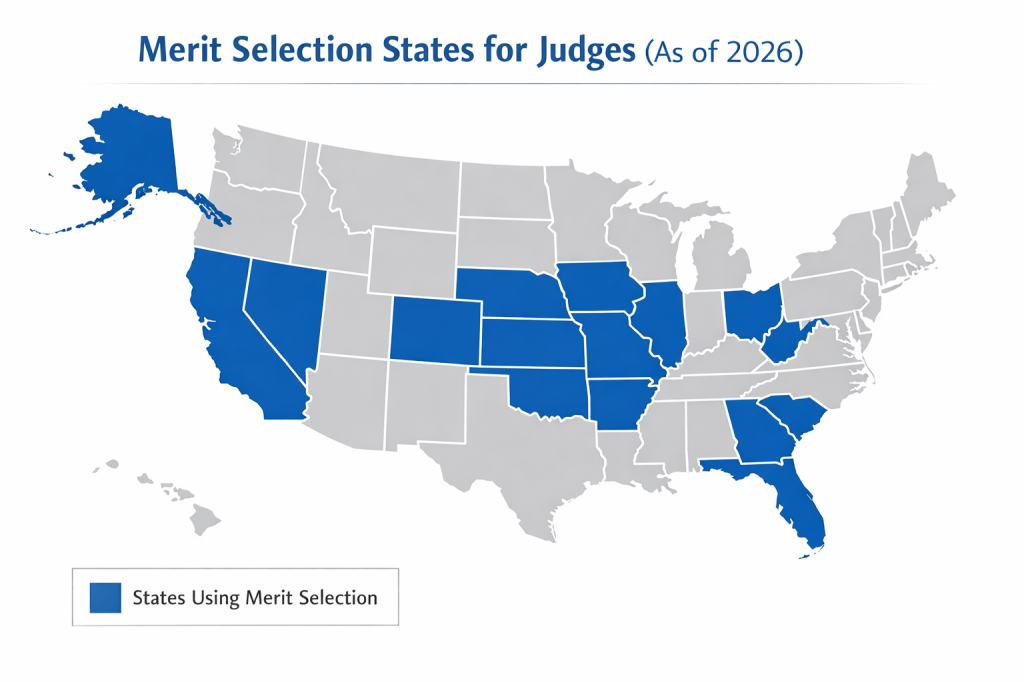
While each state’s system varies, they share the same core principle that judicial quality should not depend on who can raise the most money or run the flashiest campaign.
The problems with judicial elections are not theoretical. When judges must raise money, they often turn to the very lawyers, law firms, and interest groups who may later appear before them. Even if a judge remains completely fair, public perception is one of an unfair playing field. Justice O’Connor repeatedly warned that this dynamic creates the impression that “justice is for sale,” and that perception alone can erode confidence in the courts. Judges should not have to beg for money, nor should they be placed in situations where donors expect access or favorable outcomes.
Campaigning also forces judges into a political role that is fundamentally at odds with judicial neutrality. They must appeal to partisan voters while trying to maintain an appearance of impartiality. A judge who knows that an unpopular ruling could trigger a well‑funded campaign against them may feel pressure, even if only unconsciously, to rule with electoral consequences in mind. That is not how justice should function.
Merit selection is not perfect, and I know many strenuously object to a system that removes voters from the process of placing a new justice on the court. But if one is truly interested in how the court can better serve the people and strengthen the integrity of the institution, I can think of no better course correction than merit selection.

 Caffeinated Politics
Leave a comment