
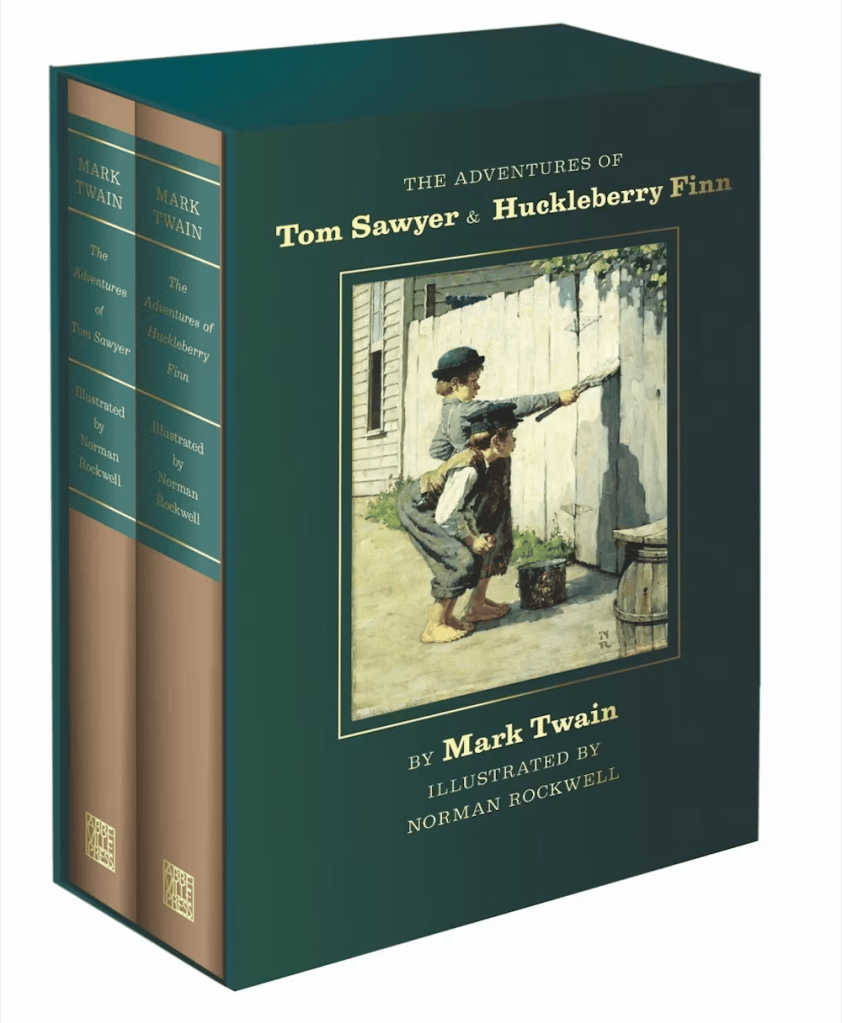
An early-20s couple passed our home while James and I raked leaves. Always chatty with passersby, I asked if they knew how fun raking leaves was. They smiled, and I said their reluctance must be because they’d read Tom Sawyer. Both admitted they hadn’t read the book, and I got the strong impression they weren’t putting the conversation in proper context, so I quickly explained that Tom was supposed to whitewash a fence on a Saturday morning. A friend comes along, and he acts deeply absorbed and enthusiastic, claiming that whitewashing is a rare and special privilege that only a master painter can do right. Soon, the friend does the whitewashing while Tom watches.
Once, a high school diploma practically guaranteed that a student had spent at least a little time floating down the Mississippi River with Huckleberry Finn or watching Tom Sawyer scheme his way out of trouble in a sleepy Missouri town. Graduates once understood that they occupied an important place in American literature. Today, most people cannot say they have read either The Adventures of Tom Sawyer or Adventures of Huckleberry Finn. Let me be upfront and honest. That shortcoming should concern anyone who believes education is about more than simply acquiring job skills.
Mark Twain was not just a novelist. He was one of America’s sharpest social observers. His writing captured a nation wrestling with its own identity, contradictions, prejudices, ambitions, and moral failures. Reading Twain is like hearing America speak in its own voice. Sometimes noble, often flawed, frequently funny, and almost always honest. When people ask me what history books they should read, I tell them to pick up Tom and Huck.
In far too many classrooms, Twain’s work has landed with cultural critics pointing to language that includes racial slurs and other terms that rightly offend modern readers. Those words are uncomfortable. They should be uncomfortable. But discomfort is not the same thing as danger. The offensive language found in Twain’s books did not originate with Twain. He did not invent nineteenth-century prejudices. He recorded them. He presented them to readers as evidence of what our history once was.
One of Huckleberry Finn’s enduring strengths is that it forces readers to confront the moral sickness of slavery and racism through the eyes of a young boy. Huck struggles between what society has taught him and what his conscience tells him. His friendship with Jim remains one of the most profound examinations of humanity and morality in American literature. The novel’s power comes precisely because it depicts a society poisoned by racism, not because it endorses it.
Pretending those realities never existed does not make us wiser. A troubling intellectual laziness is the growing assumption that difficult books should simply disappear. Rather than teaching students how to think critically about troubling language and historical context, some would prefer to avoid the discussion altogether. That is not education.
Twain’s genius lay in his ability to hold up a mirror to American society while making readers laugh at its absurdities. He understood hypocrisy better than almost any writer who has ever put pen to paper. Much of what he wrote more than a century ago still feels startlingly relevant because human nature has not changed nearly as much as we like to imagine.
My bottom line is that a society confident in its values should not fear old books. It should read them, discuss them, debate them, and place them in their proper historical context.


Leave a Reply