History demands that we choose our words more carefully than our passions would prefer. After a 12-hour Madison City Council meeting where tempers flared and emotions ran free of reason as 140 members of the community spoke, and after the lopsided 14-6 vote that fired the city’s interim police monitor, Aeiramique “Meeka” Glass, we were then told by social justice advocates that a legislative lynching had occurred.
Former alderwoman Marsha Rummel, who represented my district for many years, posted the picture below on Facebook. When I first saw it, I sat back in my desk chair and simply stared. Then I realized I was sad. How a horrific and violent and deadly chapter of our history could be warped to shape a twisted perception of what had transpired in a council meeting was stunning to me. The fact that a former alder, who worked within the confines of due process and council rules for years, had posted it so casually truly set me back. (I use Rummel as my example, as I truly expect more from her.)
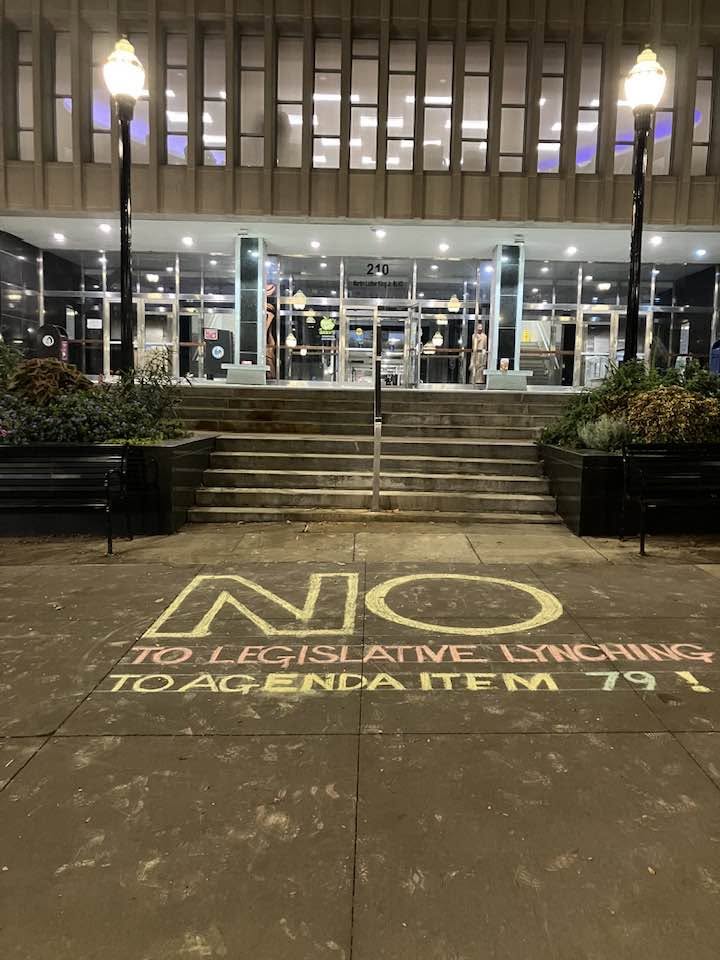
I come at this issue from a historical background. One does not just toss about the word lynching like it was just another word. It is appalling to me that people seem unaware of its gravity. Marsha and those who bandied the word about on Wednesday need to be told that the word lynching is not a synonym for losing a vote. It is not a substitute for “I didn’t get my way.”
In America, a lynching was something violent, terrifying, and unforgettable. It was a mob asserting power outside the rule of law. It was terror as public spectacle. Ropes hung from trees, crowds gathered for photographs, families were shattered, and communities were intimidated. It was the enforcement arm of racial oppression in large swaths of the nation. Thousands of Americans, overwhelmingly Black, were murdered through lynching.
That history deserves better than casual appropriation by a former alder in our city. As a decades-long reader of history, I must state a fundamental fact I hoped more pople knew. Words matter precisely because history matters.
Wisconsin has seen this kind of irrationality before. During the unrest of 2020, protesters surged onto the State Capitol grounds in Madison and tore down the statue of Hans Christian Heg, a Norwegian immigrant who opposed slavery and served as a Union colonel during the Civil War. Heg fought for the United States Army against the Confederacy. He literally fought against the political system built upon the enslavement of Black Americans. Yet the protesters decapitated the statue.

Ignorance of history rarely arrives wearing a sign that says “ignorance.” More often it arrives wrapped in certainty. People become so convinced of their righteousness that they stop asking basic questions. Who was this person? What happened here? What does this word actually mean?
From time to time, I have been able to tutor younger people in their history classes. When I have the opportunity, I try to press large themes and topics that fit the moment. If a teenager were in front of me as this issue presses down on our city, I would make the following observation. I offer the same thoughts for those in our city who use the word lynching so lightly.
History is not a large trunk, akin to what you might find in your grandma’s attic, from which we pull out dramatic language whenever we need emphasis for our present events. The past is of real people who lived, suffered, struggled, and died. Those who were victims of lynchings deserve their memories to be respected and the word best used to describe their brutal ending, not to be cheapened by distorting the meaning of what they experienced.
The lazy and lame local wordsmiths who tossed around “legislative lynching” in the last 24 hours would benefit from that lesson.


Leave a Reply