
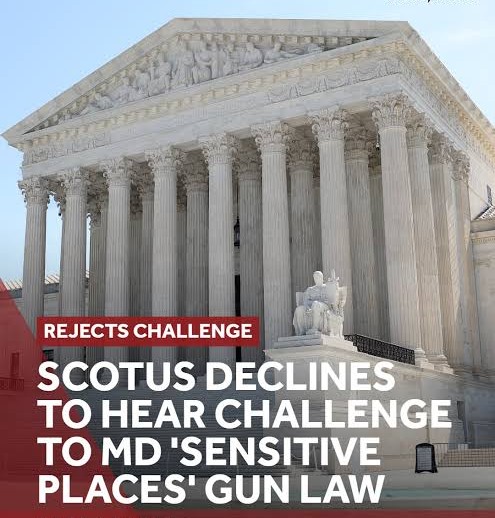
Unreasonable pro-gun advocates have taken another loss at the Supreme Court.
Today, the Court left Maryland’s restrictions on carrying firearms in certain public places intact, which shouldn’t be controversial. In fact, it should serve as a reality check for those who insist that any limit on where guns can be carried is somehow an assault on constitutional freedom. As I said, these people are unreasonable.
Maryland enacted the law in 2023 after the Supreme Court’s 2022 ruling dramatically expanded gun rights by finding, for the first time, that the Second Amendment protects an individual’s right to carry a firearm outside the home. (A ruling I deplore.) Gun-rights activists often portray that decision as a mandate for widespread public carry nearly everywhere. It was not. Maryland responded by establishing limits on carrying firearms in locations such as schools, healthcare facilities, public transportation, state parks, and businesses that serve alcohol. The refusal to hear a broad challenge to those restrictions allowed them to remain in force, a major win for gun control advocates nationwide.
Perhaps the most overlooked part of the gun debate is that the notion of “sensitive places” is not some invention of modern liberals or columnists on the Madison isthmus. It comes directly from the Supreme Court’s own jurisprudence. In the landmark 2008 decision that first recognized an individual’s constitutional right to possess a firearm, conservative Justice Antonin Scalia carefully stressed that the ruling should not cast doubt on laws forbidding firearms in sensitive places such as schools and government buildings. Pro-gun absolutists refuse to acknowledge that rights exist within limits, and public safety matters.
Gun zealots are always fearing things that no reasonable person would entertain. What the pushers of even more gun access forget is that no constitutional rights are unlimited. The First Amendment protects speech, but not defamation, threats, or fraud. The Fourth Amendment guards against unreasonable searches, not every search. Likewise, the Second Amendment should not be interpreted as a guarantee that firearms may be carried into every corner of public life. Normal Americans should be able to send their children to school, board a city bus, visit a hospital, enjoy a state park, or sit down at a restaurant without wondering who around them is armed. Nurses should not have to treat patients while worrying that a heated confrontation could suddenly involve a firearm. I know this baffles the deluded NRA crowd, but the vast majority in our country like to have the basic ingredients of a civilized society in place and not feel threatened by gun-toting wack-jobs.
More guns in more places does not mean there is more freedom. America has already run that experiment, and it is failing miserably, hour by hour. We are awash in firearms and have endured the deadly consequences. We know that some places demand higher standards of security and responsibility. We should not abandon that common everyday wisdom because a vocal minority insists that any inconvenience is tyranny.


Leave a Reply