History, when told well, has the pulse of a thriller. Over the past few decades, the quality of the narratives from historians and writers has increased, ranging from Herbert Donald Smith, David McCullough, Ron Chernow, and Erik Larson as they stoked boundless enthusiasm on the printed page for the lives and times of Abraham Lincoln, Harry Truman, Alexander Hamilton, or the deadly and devastating 1900 Galveston hurricane.
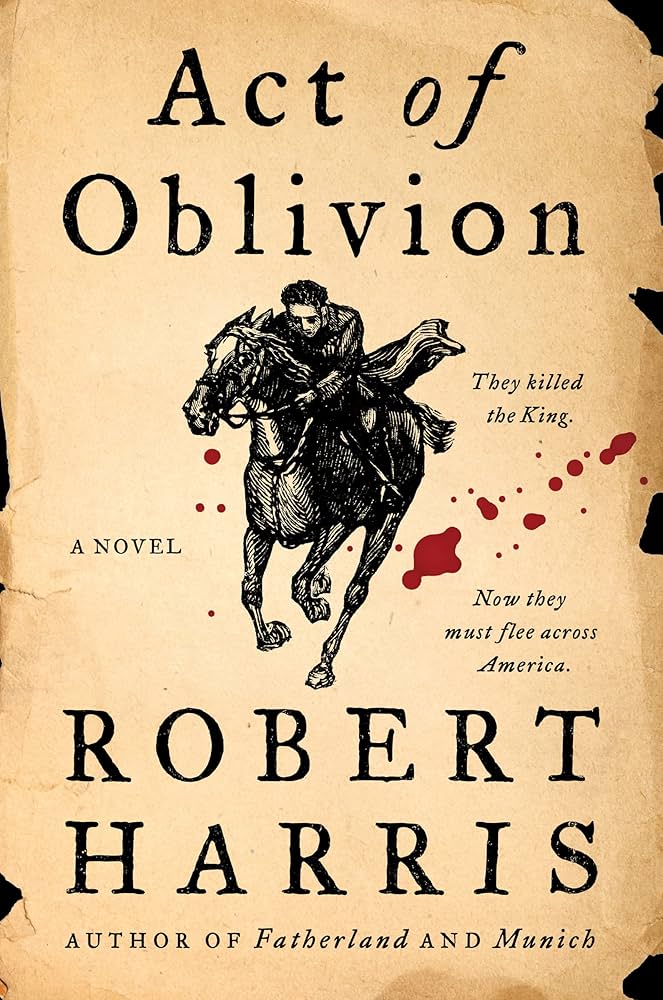
Another writer who can be rightfully listed under the term masterful is Robert Harris. I first read his “Cicero Trilogy” and was taken by his research and grasp of the time period. Then, using the skills of a gifted writer, the events and personalities were blended into books that demanded to be read almost one after the other. As the New Year begins, I wish to comment on the last book I read in 2025. It was a slice of history from the 1660s, Act of Oblivion. As the book opens, we are in the aftermath of the English Civil War, with Charles II restored to the throne and Parliament passing the Act of Oblivion. There were sweeping pardons for most who fought against the crown, but not for the men who signed Charles I’s death warrant. For them, mercy is WAY, WAY off the table.
After some of the trials where a person was found guilty, the sentence was totally absurd. The person was hanged until unconscious, then cut down and revived, only to be disemboweled and his innards burned in front of him, to be followed by a beheading, and then finally quartering. Thereafter, his pieces would be placed on pikes around London for all to see. What barbaric and sadistic mind created that punishment?
Two of the 59 men who placed their signatures on the death warrant for King Charles, Edward Whalley and William Goffe, will flee across the Atlantic to Puritan New England. Harris paints them not as faceless rebels but as flesh-and-blood figures, bound by a deep and abiding faith, loyalty, and the ever-gnawing fear of capture. Their pursuer, Richard Nayler, is the embodiment of vengeance. It should be noted that history has lost the name of the real person who led the pursuit and was relentless in his efforts to bring the men to justice under the British legal system. The mounting tension between fugitive and hunter drives the novel forward, but Harris never lets the chase overshadow the deeper questions. And that is how I come to again place Harris under the term masterful.
What does, after all, justice mean after a civil war? How can a society truly forgive when blood has been spilled in the name of politics? Or when a sovereign has been murdered?
The book’s power lies in its duality. On one hand, it is a well-researched historical novel, steeped in the grit of 17th-century England on one side of the globe and the raw wilderness of colonial America on the other. We witness exile, survival, and the uneasy balance between mercy (whatever that might mean) and revenge (whatever that might mean). Harris’s prose is mental theatre at its best, carrying readers from candlelit chambers in London to the harsh, deep snows and bitter cold winters of Massachusetts with equal conviction.
Over the many years, Harris has been rightfully praised for his deep research and historical accuracy, and for the strong narrative that urges readers onwards to another chapter. In this book, Harris makes the reader pick a side to be on as the moral ambiguity is settled only within the reader’s mind. Whalley and Goffe are fugitives, yes, but also men of conscience, wrestling with the weight of their choices. Nayler, meanwhile, is no Hollywood type of pursuer. He is a man shaped by loyalty to a king who is murdered, and his pursuit is as much about duty as it is about a personal obsession.
In the end, Harris leaves us with a question that echoes beyond the 17th century: how do nations reconcile with their own acts of violence? The Act of Oblivion was meant to draw our attention to a rich story from the past. But as we know, again and again, history resists a neat closure.
For the record, I have never landed on the side of those who killed the king. But Harris does make the two men hunted in the colonies human and allows the reader insight into their motives and principles. The book is most compelling.
To all my readers, may many grand books be found in your hands in 2026.
(If I get my column finished, the first book of 2026, 1929, will be commented on soon.)


Leave a Reply