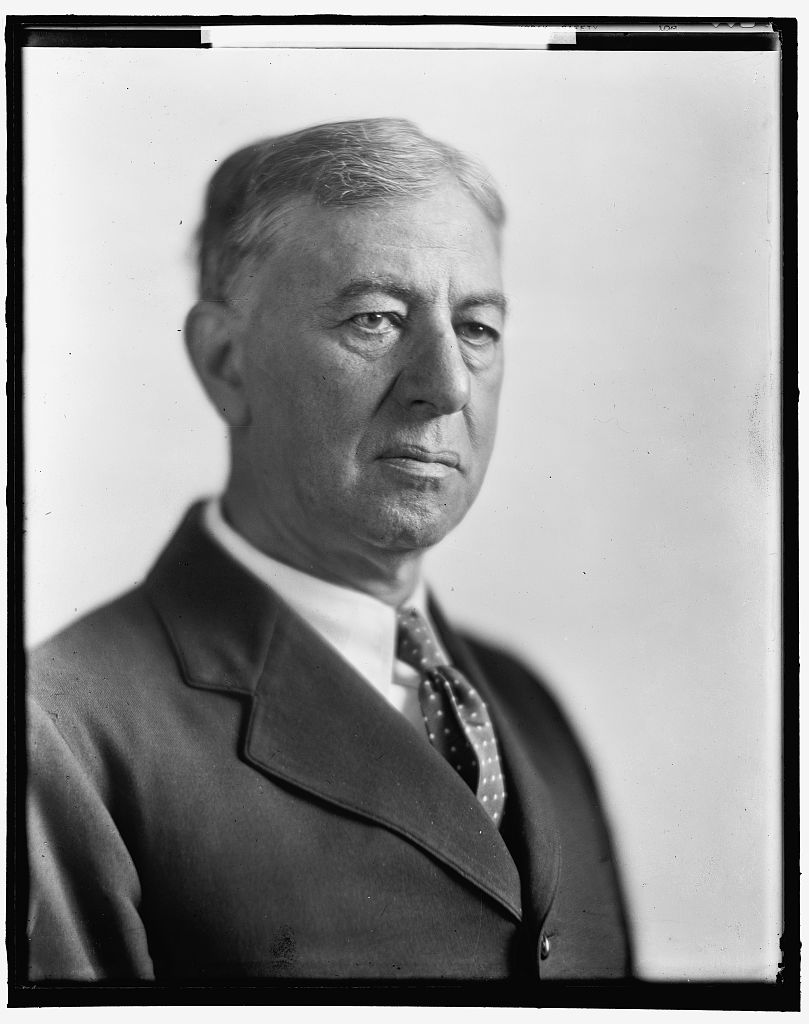
I want to write this column about a newspaperman who understood the times in which he lived and then worked to report on what it meant for the people. He also revolutionized political marketing as the first party official dedicated to media outreach. When reading 1929 by Andrew Ross Sorkin, which contains many memorable personalities, it was Charles Michelson, the former newspaperman who became the Democratic National Committee’s chief publicist in 1929, who truly intrigued me.
There are figures in American political history who never held office, never commanded a bureaucracy, never signed a bill—and yet shaped the nation’s civic imagination more profoundly than many elected officials. Charles Michelson was such a person.
He is often remembered as a partisan brawler, the man who coined “Hooverville” to describe the shantytowns that spread across the country as the Depression deepened. But that shorthand undersells him. Michelson was not merely a clever phrase-maker. He was a man who saw the data of the nation from stock market sales to farm incomes and knew a problem was brewing. There was absolutely deep animosity toward President Herbert Hoover, which was at times petty and in part manufactured for political gain. But at the core was a journalist’s instinct for truth.
Before he ever sharpened his pen against Hoover, Michelson had lived a life that trained him to recognize the fragility of life all around him, be it economic, political, or human. He had been a sheepherder, a miner, a teamster, a war correspondent imprisoned in Morro Castle during the Spanish‑American War, and eventually the chief of the Washington bureau of the New York World, a powerful newspaper in its day. He had been with The World from 1917 and for thirty years before that had been one of William Randolph Hearst’s star reporters on newspapers in New York, Chicago, and San Francisco.
By the time he joined the DNC in 1929, he brought with him not just a newspaperman’s skepticism but a moral clarity about power. He had watched it being wielded on one end and then saw the impacts on who benefited or suffered from it on the other end.
Herbert Hoover entered office in 1929 with a landslide victory and a reputation as a technocratic savior. But as the economy began to unravel, Hoover clung to an older model of the presidency, so he is remembered as being aloof, restrained, convinced that public reassurance mattered more than public action. Michelson was opposed to such a strategy.
He understood that Hoover’s refusal to acknowledge the scale of the crisis was not prudence but paralysis. He understood that the president’s faith in voluntary cooperation and private charity was disastrously mismatched to the financial collapse unfolding across the nation. And he understood that the country needed not just policy but honesty, something Hoover, with his carefully managed press access and pre‑modern communications instincts, could not or would not provide.
Michelson’s campaign against Hoover has its detractors for sure. Was he, in his role with the Democratic Party, highly partisan? Well, yes, of course. He did so because Hoover refused to use the tools of government to relieve suffering. Hoover’s optimism about the economy slid into a dangerous denial about what was happening.
One of the problems historians pin on Hoover is that he was not able to talk to the nation and use words, or as we say today, messaging, to address the pain the nation was experiencing. In that vacuum came the term “Hooverville”. Was it a smear? Or was it in the absence of any administration honesty about the national economy a mirror? A nation living in tents and packing‑crate shacks deserved to see the connection between its hardship and its leadership. Michelson gave them the language.
In the book 1929, his role does not fill the pages. His place in history has been established in many books, and it is that established understanding from other books that allows him to be viewed as a connective tissue between the private unraveling of ordinary Americans and the public failures of their government. I think he perhaps understood more than most, given his past work as a reporter, that the ongoing economic collapse was not simply a financial event but a citizen-by-citizen catastrophe.
We live in an era when political communication is often dismissed as spin, when truth is treated as just another tactic. Michelson reminds us that rhetoric can be a form of civic duty. He reminds us that naming failure is not disloyalty but a national responsibility. And he reminds us that sometimes the fiercest critics are the ones who love their country enough to refuse euphemisms.
Charley Michelson was right about Herbert Hoover. Not because he was a partisan, but because he was paying attention. That is a much-needed lesson for us all here and now.


Leave a Reply