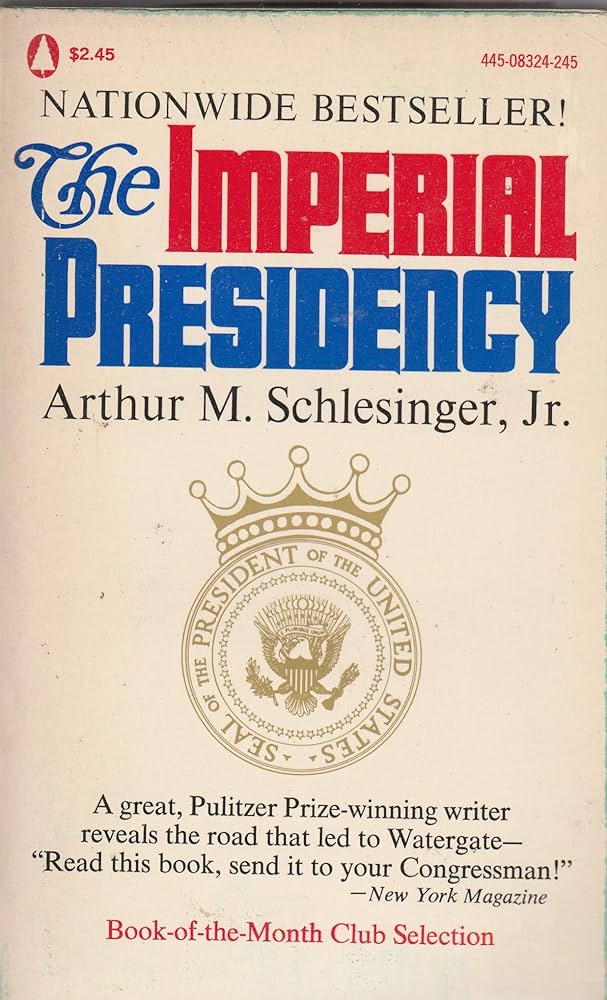
Arthur Schlesinger Jr.’s The Imperial Presidency was designed to be a warning flare fired across the bow of American democracy, but revisiting it as the new year started in light of Donald Trump’s actions gives it an even sharper edge. I first read this book when living in Sturgeon Bay, during President Reagan’s second term. The author wrote it in 1973 in the shadows of Vietnam and Watergate, when the country was grappling with the realization that the presidency had swollen far beyond what the framers intended. His argument was straightforward but profound: the executive branch, left unchecked, will accumulate power at the expense of Congress, the courts, and ultimately the public. What he could not have known is how prescient his analysis would feel half a century later, when many scholars and commentators would point to the Trump administration as a vivid illustration of the very tendencies the author chronicled. (Schlesinger would be one of those people I wish could be heard from again in light of present conditions.)
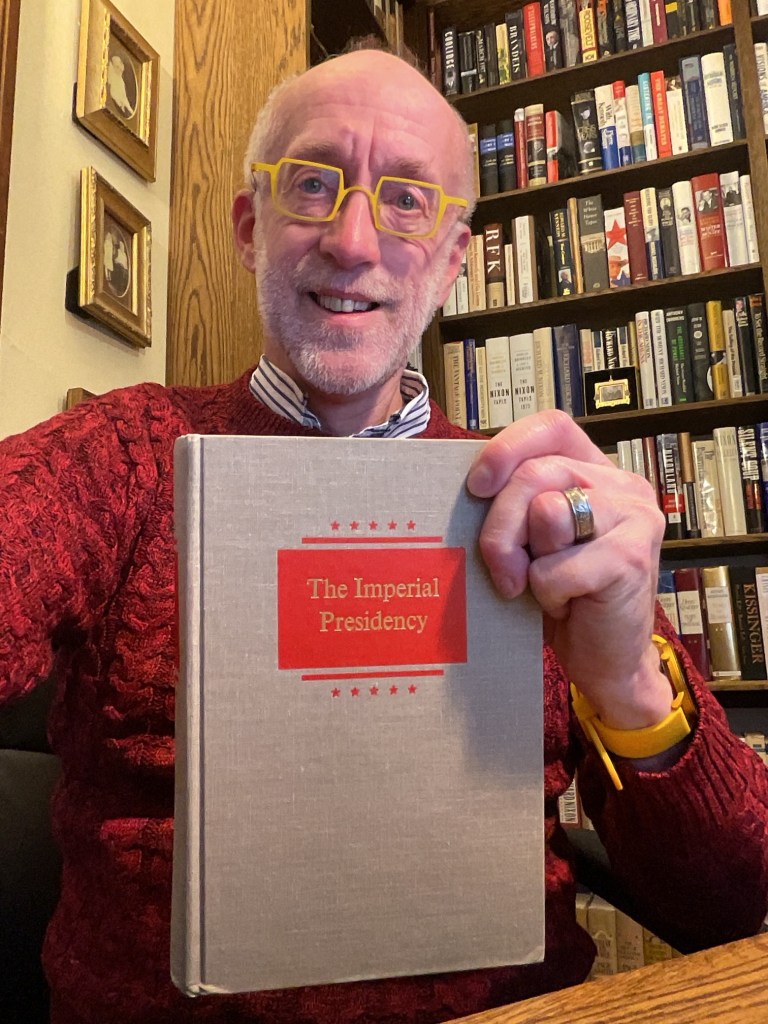
Schlesinger described the imperial presidency as one that thrives on secrecy, unilateral action, and the steady erosion of oversight. Critics of the Trump administration frequently invoke this framework, correctly arguing that the patterns Schlesinger identified have reemerged with new force. The 2019 national emergency declaration to redirect congressionally appropriated funds for border wall construction became one of the most cited examples. Legal analysts noted that this move tested the limits of emergency powers in a way that echoed Schlesinger’s concerns about presidents bypassing Congress by invoking broad, loosely defined authorization. The debate was not merely about policy but about constitutional structure: who controls the purse, and what happens when a president asserts the right to override legislative decisions.
As we know, these types of actions by Trump in his first term were tame compared to what he has undertaken in his second term. There has been a flurry of national emergency declarations, more so than any modern president. Trump’s actions, from Inauguration Day forward, have raised constitutional concerns that we must acknowledge as his overreach and strong desire is to further the imperial presidency.
On January 20, 2025, Trump signed a National Emergency at the Southern Border and a National Energy Emergency. He invoked a statute that allows diversion of military construction funds only when a national emergency “requires use of the armed forces.” This creation of a national emergency for partisan purposes is simply not allowed. Congress controls federal spending, and the funds were not designed to let a president redirect billions in appropriated military construction funds for unrelated projects. What happened was that Trump’s declaration manufactured the “emergency” which triggered a process to unlock powers Congress had not specifically granted for these purposes.
His tariff policy was premised on national emergencies, as he used such a claim to justify increases for Mexico, Canada, and China. But here is the thing. Tariffs are traditionally a congressional power under Article I, and therefore, Trump used emergency powers to circumvent Congress’s role in trade policy. There was no “emergency” but rather a policy disagreement with trade partners. He never sought congressional approval or negotiation about tariffs. (As of this posting, the Supreme Court sits on its decision about the constitutionality of this matter.)
By late 2025, Trump had declared nine new national emergencies, covering energy, trade, immigration, foreign relations, and drug enforcement.
Our legal history shows, as Schlesinger describes, that presidential prerogatives about emergencies could not be exerted every time a president proclaimed a crisis. In 1807, we read that the judicial response to President Thomas Jefferson’s overreaction to the Aaron Burr conspiracy had created certain practical limits on presidential emergency power. In 1952, the judicial response to President Harry Truman’s overreaction to the steel mill strike also received pushback from the Supreme Court concerning executive powers.
Also needing our consideration today is how past presidents, such as Abraham Lincoln and Franklin Roosevelt, usurped power in times of national emergencies, but they created no constitutional precedents. We know Trump has acted without caution or any scrupulous consideration about the dangerous precedents he could be ushering into our governmental process.
The sheer volume of emergency declarations underscores a reckless pattern of using them as a policy tool, not as a crisis response tool. If there is any need for a textbook example of executive overreach, I believe this would be the perfect place to start. Using emergency powers to bypass Congress on major policy areas simply cannot be allowed within the framework of our government. Consider that Trump issued eight national emergencies in his first 100 days, more than any person in modern times who sat in the Oval Office.
The tension between the executive branch and congressional oversight (oversight that should be mustered but has been absent from the GOP majority in Trump’s first year of his second term) was designed to sharpen and highlight the boundaries of how power is amassed and used within our government. During the Trump years, disputes over subpoenas, testimony, and access to documents became central political battles. Commentators argued that the administration’s sweeping assertions of executive privilege and its resistance to oversight efforts resembled the Watergate-era struggles that originally inspired Schlesinger’s book. The question was not simply whether a president could refuse cooperation, but whether the mechanisms designed to hold the executive accountable were still capable of functioning in an extremely polarized political environment.
Concerns about the domestic use of federal force have brought Schlesinger’s analysis back into public conversation. His book devoted considerable attention to the dangers of unchecked military power, both abroad and at home. During the Trump administration, debates over the potential invocation of the Insurrection Act and the deployment of federal ICE agents to cities like Portland and Minneapolis prompted many scholars to revisit Schlesinger’s arguments. They contended that these episodes demonstrated how easily emergency or quasi-military powers could be activated, and how fragile the boundaries are between legitimate federal authority and coercive overreach.
Perhaps the most philosophically resonant connection between Schlesinger’s work and the Trump era came from the administration’s expansive claims of presidential immunity. Schlesinger warned that the imperial presidency rests on the belief that the president stands above ordinary legal constraints. Critics pointed to legal arguments asserting broad immunity from investigation or prosecution, as well as public statements suggesting that Article II granted sweeping personal authority, as examples of the mindset Schlesinger feared. These claims, they argued, reflected a conception of the presidency that approached the “monarchical” tendencies he described.
What makes The Imperial Presidency so enduring is that it does not treat executive overreach as a partisan phenomenon. Schlesinger, a Democrat, criticized presidents of both parties and insisted that the problem was structural, not ideological. The presidency expands, he argued, when Congress, the courts, and the public fail to enforce limits. Many analysts believe the Trump era exposed just how vulnerable those limits remain.
Schlesinger reminds us that Napoleon’s maxim was that the tools belonged to the man who could use them. Supreme Court Justice Robert Jackson wrote at the time of the Truman steel strike case that, “We (the Court) may say that power to legislate for emergencies belongs in the hands of Congress, but only Congress itself can prevent power from slipping through its fingers.”
At the time of President Lyndon Johnson’s war in Vietnam, the author wrote a most telling sentence. “In the consciousness of the executive branch, the legislative branch existed as an irrational force, to be ignored as long as possible, then to be humored, managed or circumvented, never to be sought out as a possible source of intelligent advice.”
Polarization can weaken congressional oversight. That is a severe understatement given what we witnessed in 2025 and as this new year opened. Emergency powers remain broad and often overly ambiguous. Norms once governed a president’s actions, just as laws do. But as we know, presidential restraint is absent from this White House. In this sense, Schlesinger’s book reads less like a historical account and more like a manual for understanding the constitutional stress tests of the twenty-first century.
The Imperial Presidency is not just a book about the past; it is a lens through which the present comes into focus. The concerns Schlesinger raised in 1973 have not faded; rather, they have intensified, resurfacing in new forms. It reminds us that the balance of power is never permanently settled. Whether one views the Trump presidency as a totally bizarre disruption of reason and logic or a dangerous expansion of executive authority, Schlesinger’s framework offers a powerful way to understand the stakes. His central message endures: the health of American democracy depends not on the virtue of any single president but on the strength of the institutions designed to constrain them.
I understand this book is not a sexy read. No one ever took it to the beach for a summer frolic. But it is a vital read considering the place we find ourselves as Americans in 2026. I strongly encourage my readers to pick up a copy and think about the topics that so strongly resonate.


Leave a comment