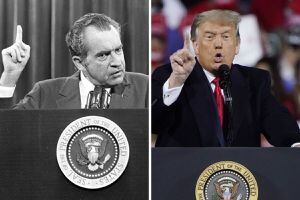
A woman walking in front of our home today stopped to chat about spring-like weather, and of course, the state of the nation. She had noticed several American flags flying upside down. I told her of many flags seen in a similar fashion across Madison over recent weeks. We agreed that what is playing out now can not be compared to other chapters of the past. I mentioned that history has proven over the past century and a half that presidential scandals have periodically shaken the nation (about every fifty years), each revealing something about the vulnerabilities of the office and the character(or lack thereof) of the individuals who occupy it. There was the President Ulysses Grant Scandal of 1873, the President Warren Harding Scandal of 1923, the President Richard Nixon scandals over several years, let us just land it in 1973, and now we are neck-deep in the Donald Trump Scandals.
President Grant, the famed Civil War hero turned president, found his administration engulfed by the Whiskey Ring, a sprawling conspiracy in which government officials and distillers colluded to evade liquor taxes. Grant himself was not personally implicated, but his deep loyalty to friends and how they used that ‘weakness’ absolutely tarnished his reputation.
Harding’s administration became synonymous with Teapot Dome, a scandal that involved the secret leasing of federal oil reserves to private companies in exchange for personal loans and gifts. Teapot Dome was a classic example of public resources being traded for private gain.
Richard Nixon’s Watergate scandal, however, marked a profound shift in the offenses coming from the Oval Office. What began as a break‑in at the Democratic National Committee headquarters unraveled into a sweeping abuse of presidential power. Nixon and his aides orchestrated a cover‑up, misused federal agencies, and attempted to obstruct justice in ways that directly challenged the rule of law. The scandal forced Nixon’s resignation and led to major reforms in campaign finance, intelligence oversight, and executive accountability. Watergate was not about personal enrichment; it was about a president turning the machinery of government against democratic institutions.
It is against this historical backdrop that we can agree and successfully state that the scandals surrounding Donald Trump represent something even more dangerous. I do not make that statement from a partisan perspective, but rather based on the scale, breadth, and nature of the controversies. Unlike earlier scandals, which tended to revolve around a single scheme or abuse of power, the issues involving Trump span business practices, conflicts of interest, handling of classified information, efforts to overturn the 2020 election, pressure on state officials, and the events of January 6. A fourth grader could easily argue that the sheer number and variety of these controversies create a systemic challenge to our nation and the foundations of democracy. No one can claim this is an isolated breach of the law.
More significantly, while Watergate was an attempt to influence an election through illegal covert operations, the efforts to overturn the 2020 results — including pressuring state officials and promoting false claims of widespread fraud — were a far more overt and sustained attempt to disrupt the peaceful transfer of power. This places Trump in a category of his own. Compounding the danger was the way the Trump operation used extreme media outlets to further polarize the citizenry. During Watergate, bipartisan pressure ultimately forced accountability. In contrast, the Trump era has been marked by deep divisions, disinformation, and the emergence of parallel realities in which large segments of the public reject factual findings, court rulings, or institutional conclusions. This erosion of shared facts weakens the nation’s ability to respond collectively to any crisis, including one involving presidential conduct.
Viewed across the long arc of history, Grant’s scandal reflected the perils of misplaced loyalty, Harding’s exposed the temptations of corruption, and Nixon’s revealed the dangers of executive overreach. He felt his presidential prerogatives extended far and wide. They didn’t.
The ugly reality surrounding Trump combines elements of all three but adds a new troubling dimension: a direct confrontation with democratic norms and the stability of the constitutional order. While I know I have taken readers into weeds with this post, what is at stake is vital to our nation. I think there is a revealing truth in that presidential scandals are never just about the individuals involved; they are tests of our nation’s institutions, our values, and our capacity to correct itself when challenged from within.
I see too little resolve from the lower middle class, those whose petty predilections landed us in the drainage ditch, to assist in greatly righting the ship of state.


Leave a comment