
“ (George) Bush and I have one thing in common, and that is that we both came in second.”
The laughter that filled the large room at the Monona Terrace in Madison in December 2007, following that comment by the Reverend Jesse Jackson, had a bittersweet sound as many in the crowd knew in their hearts that the country would have been well served by having him in the Oval Office. The comment was made during a celebration for the 90th birthday of Madison’s progressive, then-afternoon newspaper, The Capital Times. John Nichols, the associate editor of the paper, held an insightful and illuminating conversation with the civil rights activist and two-time presidential candidate.
News of the death of Jesse Jackson, one of America’s most influential Black figures, hit like a hard punch this morning. While news of his declining health situation had been reported for many months, the reporting of his death still landed hard. I recall him, like many around the country, as charismatic, a man of convictions, and a man who could produce a most infectious winning smile across his face. The memories this morning about this important part of our nation’s political story run deep.
Over the decades, I have been fortunate to have seen and heard the man speak, but it was in 1988 when I worked in the office of State Representative Lary Swoboda that I was again able to meet the man.
That year, I was enthralled with the words, style, and foundations
of the Jesse Jackson campaign. I gravitated towards his
mission of inclusion of all groups into a national mosaic. His
words spoke to me personally. His discourse centered on a metaphor:
The United States represented to him various pieces of
cloth that did not mean much by themselves. Assemble all those
various little pieces of cloth together, and they become a grand
quilt. The patchwork idea connected with how I viewed our national
needs at the time. I was also mindful that he was on the
correct path about how our nation spent far too much on military
spending, and that we too often felt compelled to use the weapons
that we had amassed.
I had first met Jackson in Stevens Point at a State Democratic
Convention, where the reverend held a Sunday morning rally. My sister and nine-year old niece, Katrina Anne, sat alongside me in the front row (on the right-hand side, political junkies recall the small things) as Jackson took the stage. He noticed my niece wearing a cute dress and waved at her while making a comment on stage about how nice she looked.
The ability of Jackson to carry a crowd and move them
to action through passion was interesting to watch as much as to listen to. But it was the night before the April Presidential primary election in 1988 that made my heart beat much faster. It was then that his campaign made a stop in the office where I worked.
My office desk was on the ground floor, next to the State Street entrance.
Directly out my window and on the steps leading down and away
from the building, Jackson was to hold his last major rally before
the polls opened. In advance of this rally, our office was informed
for security reasons that my window needed to stay shut and the
blind closed. The hallway that led from the rotunda down to the
revolving doors that exited to the rally site was filled with serious-minded
security men.
Prior to the event, a couple of Jackson’s assistants stopped
by and asked if they could leave their heavier jackets inside on a
chair. The place would be unlocked, as there was no way anyone
was taking anything, given the number of security men all about.
I asked if there was a way to meet the candidate, and was
instructed to wait in the hallway.
I still have no way of knowing if the Jackson team jogged
down the hallway for security reasons or because they felt they
were late. Perhaps this was a technique Jackson used to release
pent-up energy. All the same, a phalanx of large, muscled African-
American men in suits, along with the presidential candidate, were
jogging at a spirited pace down the hall. (If I were the type of
person to enjoy running, I might have joined them.) As the team
approached my office, one of the advance team members I had met pulled
Jackson over. Jackson stopped, smiled, and shook my hand. I
told him that his campaign meant a great deal to so many who
felt they often had no voice to represent them. He replied, “Let’s
go win this election”, and made his way towards the doors, again
at a half jog.
Outside, as the late afternoon sun set, Jackson delivered
one of his famous barn-burners of an address, leaving people
holding hands with the person alongside whom they were standing.
I had found a spot next to the building and looked out at the
faces, but I will never forget the one next to me. A man I did not
know, about my age, had tears running down his face as Jackson
vocalized the hopes of the nation and painted the picture of what
America could look like if we all worked together.
Throughout the 1988 presidential election season, I wore
Jackson’s campaign button on my jacket. I had been a supporter
of Jackson in 1984, but was not able to campaign and work on
his behalf to the degree I had wished. In 1988, I was more proactive.
The most amusing part of this story was that Lary Swoboda, a politician who was quite conservative, was also in an election race that year in the First Assembly District. While with him in the district one day, he asked me what his constituents might think about my wearing a Jesse Jackson button on my jacket. I told him that I hoped the voters
might ask about Jackson, so I could tell them of the message he
offered for America. This seemed to make Lary mighty nervous.
He sensed that I was serious. He never talked about the button
again, though I knew he thought it might harm him among some
conservatives.
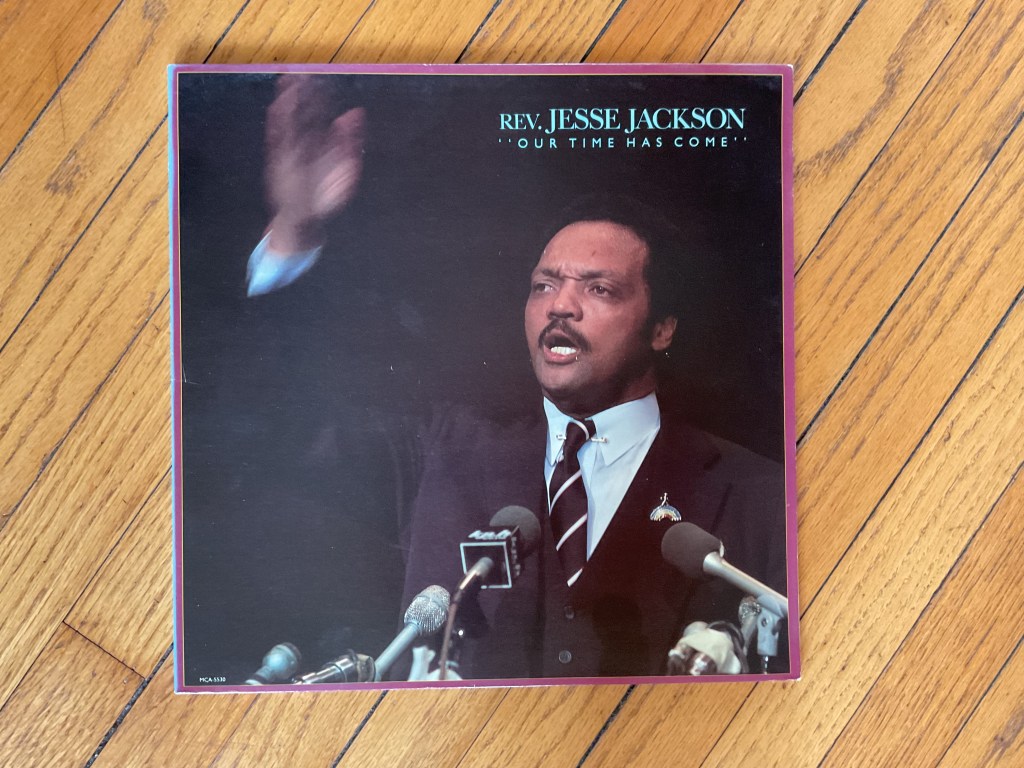
In 1984, at the DNC convention, Jackson gave a spell-binding speech, which was later sold in an LP form, a copy of which I own. Here is a portion that has long lifted the sails of the Democratic faithful.
“I’m tired of sailing my little boat, far inside the harbor bar,” he said near the end of the address. “I want to go out where the big ships float, out on the deep where the great ones are. And should my frail craft prove too slight for waves that sweep those billows o’er, I’d rather go down in the stirring fight than drowse to death at the sheltered shore.”
“We’ve got to go out, my friends, where the big boats are.”
At the 2007 event in Madison for the Capital Times, John Nichols started his introduction for Jackson by describing him as “the most successful diplomat”, and then listed the record of Jackson’s achievements, along with his thoughtful views over the decades. I wrote the following at the time.
When asked to sum up his diplomatic approach, Jackson said, “I tried, I talked, I asked.” The audience understood what he meant. As Jackson spoke of his overseas work, the crowd nodded in agreement, and when he mentioned Ronald Reagan and the American flier held captive in Syria in 1983, there was laughter.
Robert Goodman, a Navy flier, was being held by President Assad, and Jackson asked President Reagan if he could travel to Syria to seek his release. Reagan told Jackson not to go, but just in case Jackson did go and succeeded, Reagan wanted to make sure Jackson brought Goodman back to the White House for pictures! Jackson used the diplomatic approach he had long advocated; he tried, talked, and asked. In the end, a very pleased President Reagan met Goodman at the White House. And as a side note, I think we all recall that Jackson looked mighty good on the White House grounds, too!
The struggles with the power centers within the Democratic Party frustrated Jackson for many years. While working to elect an African-American mayor in Chicago, he was told by Senators Ted Kennedy and Walter Mondale that they both needed to “support their allies”, meaning they would work for the entrenched Chicago machine candidate. When Jackson heard the “allies” comment, he asked them, “Well who are we?” meaning the black voters that had supported the Democratic Party for decades. Years later, Jackson would spar with the centrist and mushy Democratic Leadership Council, which was an organization hoping to stem the liberal tendencies of the Democratic Party.
But through it all, Jackson understood that counter-culture politics is the force that keeps the nation moving in a progressive direction. Whether it was striving for union rights, civil rights, or health care rights for AIDS patients, the counter-culture politics that he marshalled is the path that he wished more politicians would embrace.
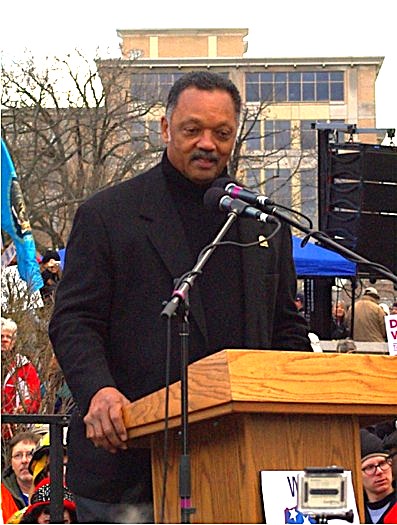
On April 4th, 2011, the anniversary of the assassination of Martin Luther King Jr., Jackson was at the Wisconsin State Capitol again. At the time, I wrote the following.
There was no way not to feel the religious spirit of Martin Luther King, Jr. as the opening music allowed for a spiritual quality to the evening. More than one person must have experienced goosebumps as the bagpipes played and the crowd sang “Amazing Grace.” There are times when ‘the moment’ just moves a crowd, and I think that was the case at the Capitol. I noticed some wet eyes at times in the crowd around me.
We come to know politicians through the media or while serving in public office. Many are forgotten once they drift from an elected position. A very few are remembered decades later not for winning, but for striving. Being an essential rung on the ladder that another person will use to make the rest of the trek to the top. That is why Jesse Jackson matters. Yesterday and today.
Godspeed, Jesse.

 Caffeinated Politics
Leave a comment