I read the following segment in Empire of Liberty by David Reynolds and took a photo of a few paragraphs. It is a telling reminder of what our past looked like, felt like, and was like. This account follows the outbreak of World War II.
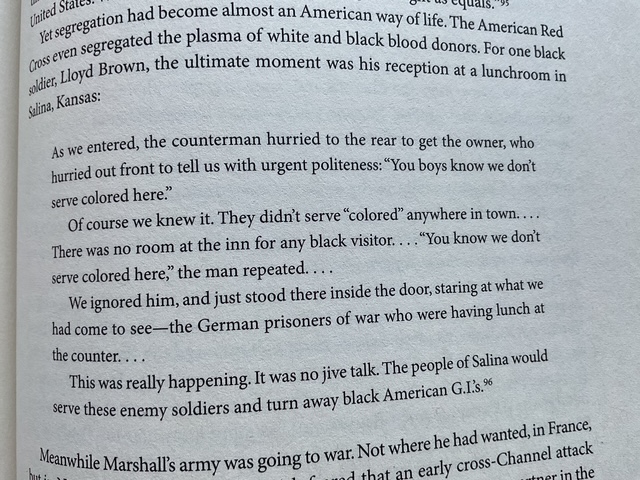
I had copied that historical nugget and kept it in my cloud files. It came to mind again when a federal judge this month ordered the Donald Trump administration to temporarily restore displays about George Washington’s ownership of enslaved people at a monument on the site of his former house in Philadelphia. The judge said the government’s claim to have the power to erase and alter historical accounts at the country’s monuments echoed George Orwell’s dystopian novel “1984.”
In a 40-page opinion, Judge Cynthia M. Rufe granted a preliminary injunction to the City of Philadelphia, which had sued the Interior Department and the National Park Service over the removal of the displays. The order means the government must reinstate the materials while the underlying lawsuit proceeds in court.
It completely baffles me why some white Americans try to remove, sanitize, or downplay historically significant documents, markers, and narratives of African American history. At the core of whatever drives these people is worrisome and deeply troubling.
When in the sixth grade, I asked the eighth-grade history teacher if I could take home, over the Christmas vacation, a copy of the American history textbook he used in his classes. I don’t recall exactly his facial response, but I am sure it was akin to asking, “What did you say?” I have been interested in history for decades, not only about our country, but also about places around the globe.
So I have difficulty trying to grasp why some of my fellow citizens, who have the same opportunities to learn our national narrative, simply refuse to be educated about the uncomfortable truth that this nation was built not only on ideals of liberty but also on centuries of exploitation, exclusion, and racial violence. Yes, it can be embarrassing to know the truth. (At a Humphrey family reunion in my middle school years, I was told by an uncle that I was an oops baby.) But trying to erase evidence of our original sin as a nation doesn’t erase the reality. It only exposes a fear of reckoning with it. A fear that acknowledging the full story of America somehow diminishes the parts people prefer to celebrate. But history doesn’t bend to comfort. It simply waits for those willing to face it honestly.
That is why US District Judge Cynthia Rufe of Philadelphia stood out for me when she ruled this month. The sheen that gets placed on George Washington, in relation to his life of service, has less luster when we talk about his slaves and how he manipulated the system to keep them.
Even though Washington’s slaves should have been freed under Pennsylvania’s gradual abolition law, Washington exploited a loophole. A slaver had to free his slaves within 6 months of their arrival. So Washington just rotated his slaves, sending them back to Mount Vernon before the six months were up and getting a new group sent to him in the city.
Not as sterling a character as our basic understanding of the man in elementary classrooms would have our youth believe. While I firmly believe that history needs to be viewed within the context of the time a person lived, I also know that the totality of a person needs to be viewed and weighed when studying history. Whitewashing the fact that Washington had slaves and mistreated them greatly is a part of the story that must be told when assessing this man.
The Interior and Park Service officials who took down the exhibits said they were simply following Trump’s orders not to display anything that could “inappropriately disparage” dead or living Americans. I cannot think of anything worse to be called in colonial America in the 1700s than a slave owner. That is the factual aspect of Washington that Trump and his infantile-minded supporters want to remove and forget.
What makes this impulse of removal even more incomprehensible is that African American history is American history. The documents, signs, and artifacts that some want to remove are not “divisive”; they are the receipts of a nation’s evolution. They show the courage of those who fought for rights they were denied, the brutality of systems that tried to silence them, and the resilience that reshaped the country in spite of it all. To strip these reminders away is to pretend that progress happened by accident rather than through struggle. It’s an attempt to curate a national memory that flatters rather than teaches.
That contempt for the past must never be allowed to stand.
Judge Rufe wrote brilliantly, and I will let the words from the ruling make the case.
As if the Ministry of Truth in George Orwell’s 1984 now existed, with its motto “Ignorance is Strength,” this Court is now asked to determine whether the federal government has the power it claims — to dissemble and disassemble historical truths when it has some domain over historical facts. It does not.
The President’s House displays recognized [slave] Oney Judge and focused on how her struggle for freedom represented this country’s progress away from the horrors of slavery and into an era where the founding ideals of “Life, Liberty and the pursuit of Happiness” could be embodied for every American.
And yet, in its argument, the government claims it alone has the power to erase, alter, remove and hide historical accounts on taxpayer and local government-funded monuments within its control.
The government here likewise asserts truth is no longer self-evident, but rather the property of the elected chief magistrate and his appointees and delegees, at his whim to be scraped clean, hidden, or overwritten. And why? Solely because, as Defendants state, it has the power.
An agency, whether the Department of the Interior, NPS, or any other agency, cannot arbitrarily decide what is true, based on its own whims or the whims of the new leadership, regardless of the evidence before it.
The removed displays were not mere decorations to be taken down and redisplayed; rather, they were a memorial to “men, women, and children of African descent who lived, worked, and died as enslaved people in the United States of America,” a tribute to their struggle for freedom, and an enduring reminder of the inherent contradictions emanating from this country’s founding. Each person who visits the President’s House and does not learn of the realities of founding-era slavery receives a false account of this country’s history.
It goes without my writing here that historical markers matter. They are not there to shame anyone; they are there to ensure we do not forget. A society that hides its past is a society destined to repeat it. The instinct to erase African American history reveals a deeper anxiety about accountability and identity, but it also reveals a profound misunderstanding: confronting history is not an attack on America; it is an act of care for its future. The truth is not always comfortable, but it is always necessary. Without it, we lose our bearings, our integrity, and our ability to grow.
During Black History Month, that is a point we need to embrace.


Leave a Reply