
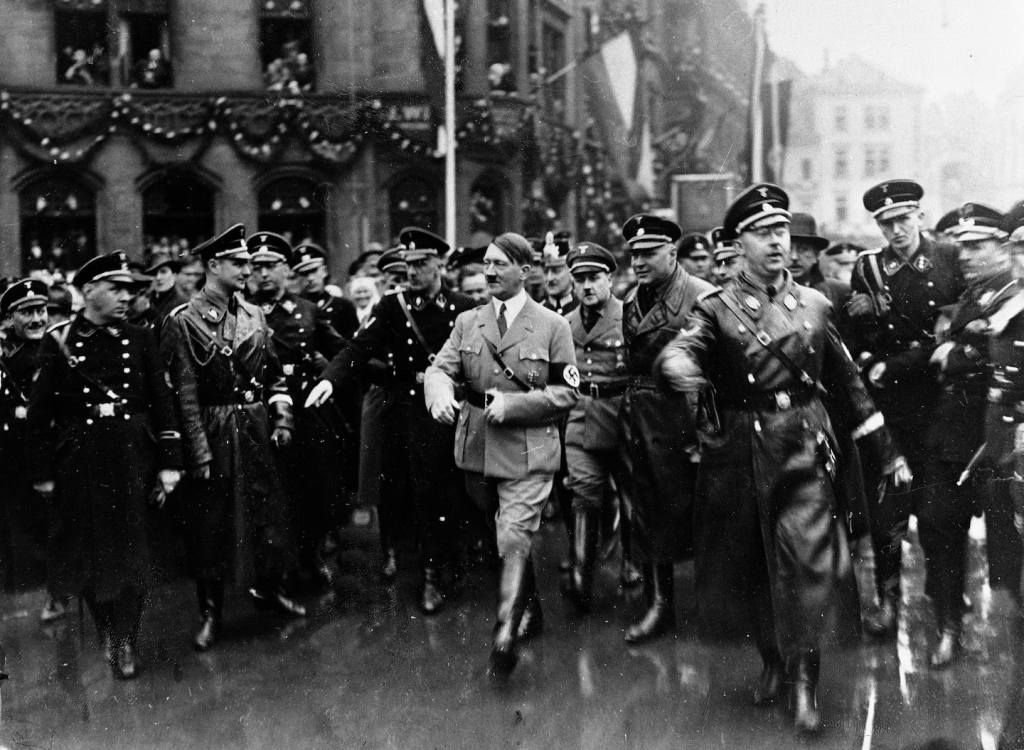
It was shortly after ten o’clock Sunday night when one of the nine people gathered around the large dining table posed the question. With a deliberative style, the question was asked about what criteria were used by German citizens who felt it necessary to leave their homeland as they witnessed the rise of Hitler and the growing menace of Nazism taking hold. Is there a template of sorts, with similar considerations and benchmarks, that Americans can or should use to have discussions about the future of this nation and what they might do?
What struck me about this larger conversation was not that it was taking place. I have heard and participated in other such ponderings, though not in the exact context as the one posed around that table. No, what struck me was who constituted this group that had gathered for cocktails and hors d’oeuvres outside and then moved inside for dinner. They consisted of lawyers who had worked at some of the largest law firms in the state, people who had held top positions in the medical school at UW-Madison, and a woman who obtained a $500,000 grant from Harvard for an educational research project in Michigan. These were people with gravitas. Resumes that sizzled. But what united them was each now hearing the faint echo of a melody played in 1930s Germany.
No one at that table thought the United States was Germany, or that Donald Trump was a carbon copy of Adolf Hitler. As I sat back in my chair, drank more of my strong-brewed coffee, and ate another dessert (yum), I saw the faces of what we would call ordinary Americans as they recognized the ground beneath them shifting. The Germans who fled as Hitler rose to power weren’t clairvoyant. They were simply paying attention to the accumulating signs that their country was becoming unrecognizable. The ones at the table seemed to agree with that assessment.
In Germany, let us not forget, the first tremors came through the legal system. The Reichstag Fire Decree, issued on February 28, 1933, obliterated personal liberties in Germany by suspending core constitutional civil rights. It laid the foundation for the totalitarian Nazi dictatorship, enabling the regime to permanently dismantle democratic safeguards until the end of World War II in 1945. The Enabling Act of 1933 was a constitutional amendment passed on March 23, 1933. It allowed Adolf Hitler’s cabinet to enact laws without the approval of parliament or the president, effectively establishing the Nazi dictatorship. Judges were pressured to rule “in the spirit of the Führer,” which meant the law no longer protected citizens but rather it protected the ruling party.
Hear me now, Hitler didn’t need to seize power with tanks; he rewrote the rules.
After returning home and with caffeine and sugar powering me, I retreated to the third floor to start working on this column. As I turned on the music and scanned news articles, the first headline, one about Stephen Miller, grabbed my complete attention. The highly influential deputy chief of staff had worked at a fevered pitch during the second term to secure Trump’s authority to suspend habeas corpus. That is not a typo.
By doing so, the locked-up immigrants (who were the targets) would be blocked from receiving hearings or even from seeking court orders to prevent their removal from the country. This was an opportunity for Trump not only to speed up deportations, but also to assert vastly expanded power over a legal system that was getting in his way. Should we be surprised that well-read and serious-minded people in our nation are concerned about our society tilting toward authoritarianism?
I suspect many people who do not pay close attention to every headline in our nation still feel the undermining of our press and the attack on journalists coming from this administration. Grasp how the Defense Department sought to make reporters mouthpieces with one megaphone. See our laws being undermined and Constitutional norms being attacked in broad daylight. So, think about those professional Germans in the 1930s who realized their work was being corrupted as doctors, teachers, lawyers, and academics, and being pressured to turn their professions into ideological tools. Was it absurd for them to contemplate giving up the nation of their birth? Is it so out of the question for people to talk about things today in the United States?
Let us also recall that the Germans didn’t flee because of one dramatic event. They fled because of a series of events, the slow accumulation of authoritarian absurdities, until the national structure around them no longer resembled a democracy.
The rise of explicit white nationalism in our nation, the framing of certain groups as “real Americans” and others as “invaders” or “enemies,” or “vermin,” echoes the old tactic of dividing a nation into pure and impure portions. Historically, when leaders define national identity in exclusionary terms, people who fall outside the favored category start checking their passports. I know that some people constantly carry their passports for protection. In the United States. In 2026.
How I evaluate the situation is not between Hitler and Trump but rather in the similarities of the people from the 1930s and those who now sit around dinner tables and talk late into the night in our country. What Germans felt with the unease and dread is what some Americans feel now. We recognize the emotional recollection of a storm that fills our history books.
Over the decades, I have read that Germans who stayed often said later that they didn’t realize how quickly the dangers and damage were unfolding due to Nazism. The Germans who left said they realized how fast it could happen. That’s the difference.
And that is why people talk about these things among friends in the United States today.

 Caffeinated Politics
Leave a comment