
In my senior year of high school, I never got to sleep on weeknights until well after 11:00 P.M. The American hostages were held in Iran, and there was a new late-night news special on ABC providing not only news but also background on the growing crisis. The program would soon be named Nightline. It was a 30-minute foreign policy course each night, and I was hooked. One of the points stressed was the need to ensure that the Strait of Hormuz was not plunged into chaos, given its significance for a wide range of commercial shipping. That was in 1979.
Donald Trump would have his base believe that no one had ever considered the possibility that the waterway might be used by Iran for a military and economic purpose. The Brooklyn Bridge is up for sale again, too.
Before I launch into the heart of my column, let me state the obvious. (But clearly not so obvious for the reckless Trump voter who thrives on laughing at intelligence and expertise.) The lack of that intelligence is why we are at this point in our country tonight, because we now have an occupant in the Oval Office who is uneducated, the very opposite of being disciplined, and without any regard for operating with a reasoning mind. As such, we have an international policy shaping up that is a danger not just to policy outcomes but to our nation itself.
The modern world demands a president who can absorb complex intelligence, understand history, and weigh competing national interests. What we have with Trump is someone who operates on whims. Trump has become an asset to our adversaries. In his first term, it was President Putin. The second term is Iran. For those in the Trump base who scoff at my words, all I can say is that mere competence is the bare minimum we must insist on for any president to sit in the Oval Office.
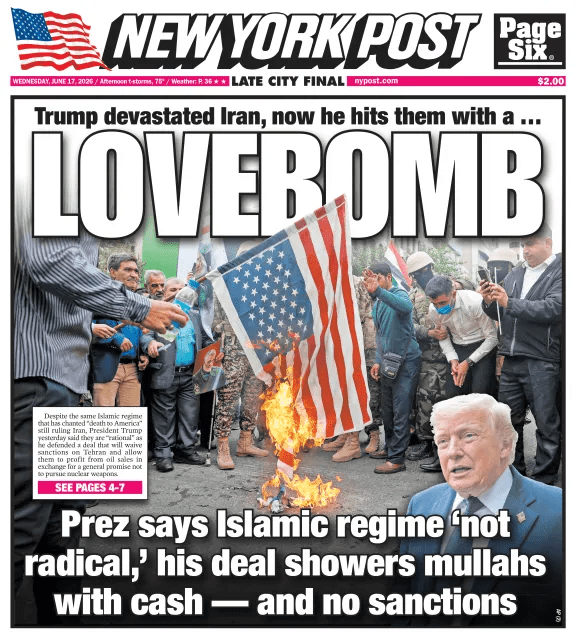
If Washington’s goal since 1979 was to contain Iran, deter its nuclear ambitions, curb its regional influence, and maintain leverage through sanctions, the new U.S.–Iran memorandum of understanding, set for ceremonial signing on Friday, reads like the obituary for that strategy. While this is a truly unfathomable next chapter in the Iran War started needlessly by Donald Trump, can we really say that it is any more unfathomable than how it started? After all, there was no rationale or reason for the first missile ever to be fired over 108 days ago.
The facts, as reported by BBC, NBC News, NPR, Bloomberg, TIME, The New York Times, and Foreign Affairs (my main sources for news), point to a simple conclusion, and it is not one that bodes well for the United States. Iran got what it wanted, and the United States gave up what it had long insisted it would never give up.
Start with sanctions. The MOU commits the U.S. to terminate all sanctions and unfreeze Iranian funds and assets, which would be an extraordinary reversal after years of maximum pressure enforced by the international community. Bloomberg’s reporting has been among the best in recent days on this matter, and it reports that Iran will gain the right to sell oil immediately and access a $300 billion development fund. I need not write it to make it abundantly clear. That is not symbolic relief; it is a financial windfall of historic scale.
The nuclear issue, supposedly the point that Trump finally settled on as his ‘reason’ for the military misadventure, will remain unresolved. TIME’s review of the agreement notes that Iran merely “reaffirms” it will not develop a nuclear weapon, using almost the exact same language that was in President Obama’s JCPOA, and now Trump is accepting the MOU, which punts any nuclear constraints to a later “final deal.” The enriched‑uranium stockpile will be addressed only through a “mutually agreed” mechanism, with the minimum requirement being on‑site down‑blending. That is a far cry from dismantlement, export, or verifiable elimination that Trump blustered about between naps in the Oval Office in front of dignitaries and the press.
Trump has publicly stated he “doesn’t mind” if Iran has ballistic missiles, so long as others do too. That is a stunning concession, given that ballistic missiles are the delivery systems for nuclear weapons.
The strategic picture gets worse. The U.S. will lift its naval blockade and reopen the Strait of Hormuz, and we need to be reminded that the Strait was open with unfettered transportation before Trump wanted to remove headlines about his sexual crimes with young girls with Jeffrey Epstein. Trying to spin the opening of the Strait as a success is a bizarre spin moment for this White House. It goes without saying that Iran has gained power from Trump’s war, as that nation knows now the actual power it has with the closure and threats to shipping in this body of water. This was not a one-off for Iran.
TIME reports that Iran may tap a $300 billion reconstruction and development fund if it meets future commitments. Bloomberg’s reporting aligns with this, writing about broad financial incentives, immediate oil sales, and access to frozen assets. Whether the funds come directly from the U.S. or through international channels, the effect is the same, as Foreign Affairs makes clear. Iran, in receiving massive economic relief without having to dismantle its nuclear infrastructure or abandon its regional ambitions, poses a regional growing power threat to the Middle East.
Experts at the Atlantic Council note that the MOU does not resolve the core issues and that, as we know, the second phase following its signing will be politically difficult, if not impossible, for all sides. In other words, Iran gets immediate gains; the U.S., thanks to Trump, gets promises of future negotiations. Nothing more.
What has caught my attention, something Foreign Affairs has stressed since Trump made his bombing raids in Iran in 2025, involves the symbolic elements that strongly favor Tehran. The agreement codifies the end of any U.S. pursuit of regime change by committing both sides to respect sovereignty and refrain from interfering in internal affairs. Hear me now. That is a major ideological victory for the Islamic Republic, which has long framed U.S. pressure as existential.
What does Washington get in return? A ceasefire, a temporary reopening of Hormuz, and Iran’s reiteration of a nuclear promise it has broken or bent repeatedly. The U.S. also gets the political risk of having to re‑enter conflict if Iran violates the deal—something the administration itself acknowledges.
This is not a balanced agreement. It is a strategic retreat dressed up as diplomacy.
And we know how we got here. With big and dumb.

 Caffeinated Politics
Leave a comment