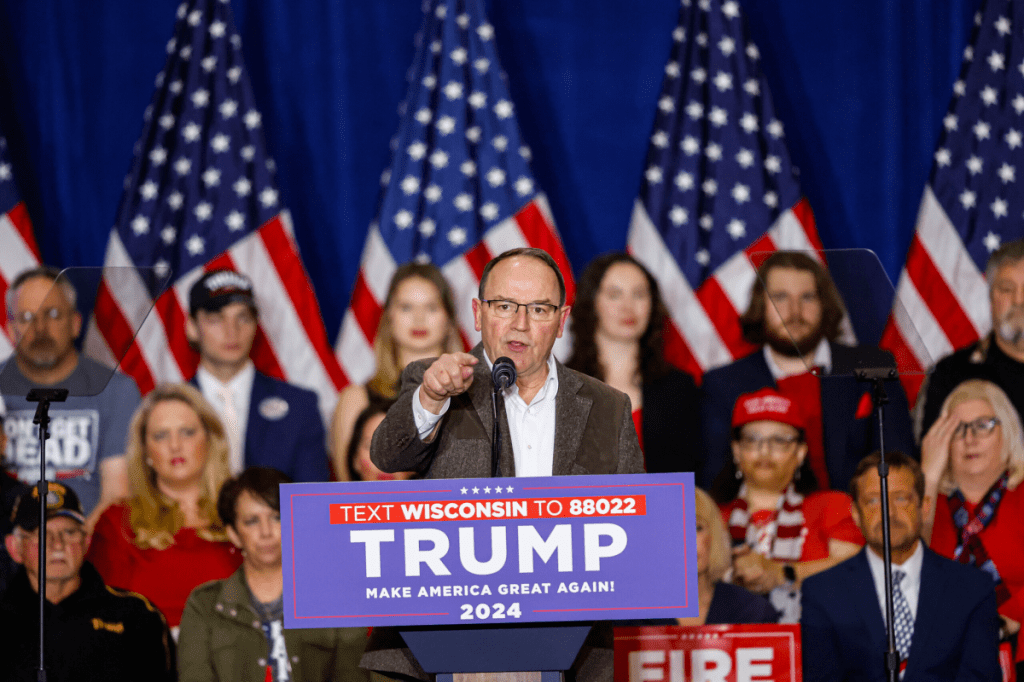
It came as no surprise that Republican Congressman Tom Tiffany received Donald Trump’s endorsement for this November’s gubernatorial race. The 7th congressional district has been represented since May 2020 by an elected official who has slavishly supported Trump. In the endorsement, Trump said the congressman is someone who has “always been at my side”. What many suspect to be the reason Trump had such kind things to say was not so much that Tiffany has consistently aligned himself with this White House on policy, but rather that he was one of only two Wisconsin members of Congress who voted against certifying the 2020 presidential election results in Arizona and Pennsylvania. He also signed a Texas-led amicus brief that sought to overturn election results in four battleground states.
Tiffany has never significantly opposed Trump on any major policy or political issues. So we need to ask what such a close bond with a politically troubled leader will pose for the gubernatorial nominee come November.
In the past couple of days, the worst approval ratings of Trump’s second term have been reported, with new polling from the NBC News Decision Desk showing that eight out of 10 Gen Z voters say the country is on the wrong track. Trump now has the support of just 37 percent of Americans, while nearly two-thirds (63 percent) say they disapprove of his handling of world affairs. Half of all American adults now say they “strongly” disapprove of how the Trump presidency is going.
With that strong sentiment being registered in every poll, one has to ponder how Tiffany aligns himself with an electorate that has opposing views on Trump’s agenda. Being a fierce Trump loyalist up for election as a Republican this fall seems as wise as wearing Viking colors for a Green Bay Packers home game.
How does this candidate, who wants to represent voters from the agricultural or manufacturing sectors, square his strong defense of Trump’s tariffs and trade wars with the reality of higher costs for farmers and businesses? How does he deal with his strong support of banning federal diversity, equity, and inclusion (DEI) programs and turning them into permanent federal law?
I am just a simple number counter, having grown up in rural Hancock. Still, I suspect that there are more angry suburban voters across the state than MAGA loyalists in the countryside who are still willing to again throw their vote with whatever Trump tells them to do. So, an adjustment from Tiffany is long overdue to meet the needs of a statewide campaign.

One only needs to cross the state line into Illinois to see the same dynamic playing out. Darren Bailey has secured the Illinois Republican Party nomination for governor. But he quickly tried to separate himself from Trump, declaring, “I am my own person.” The Chicago Tribune reported on this one race, but it reflects what many Republican candidates are facing at a time when Democrats are more motivated to cast ballots this year.
Bailey, whose evangelical Christian beliefs have been a pillar of his bids for public office, did chastise Trump for posting a now-deleted social media meme in which the president presented himself as a Jesus-like figure healing the sick as part of his criticisms of Pope Leo XIV’s opposition to the war in Iran.
“I’m a Christian and I’m an Illinoisan. President Trump mocking a Chicago-born Pope and posting himself as Jesus Christ is wrong. I don’t care whose name is attached to it — I’ll always call it like I see it,” Bailey posted Monday on the social media site X.
Bailey followed up on that with another X post on Tuesday, saying, “Look, I’ve had to eat my words before. But when you’re wrong, you say so. President Trump was wrong here and he should apologize to Pope Leo.”
We know that Trump’s highly contentious second‑term policies have created significant political risk for Republicans heading into elections. Refusing over the past year to confront Trump’s failures, along with his crude and absurd behavior, will cost Republicans electorally this fall. Here in Wisconsin, Tiffany needs to step into reality and beyond Trump’s orbit. Independents and suburban moderates, with a significant number of women voters, have shown consistent fatigue with Trump‑related polices and crazy controversies. By not tacking to the broad middle, Republicans, including Tiffany, allow writers like me to define the entire party by Trump’s unpopular actions.
Tiffany has a choice to make.


Leave a Reply