Many people are thinking about baseball or summer travels, wondering if they can afford the gas prices to head to the ballpark or the Grand Canyon. At the same time, there are very troubling events occurring involving wealthy individuals connected to Donald Trump and his administration, making wild profits on stock deals.
The morning of Monday, March 23, was quiet in the oil markets. The Iran war had been raging for nearly four weeks, but it was an otherwise unremarkable premarket session. Early-morning futures trading is, by nature, low volume, low liquidity, with few surprises. That makes unusual activity easy to spot because there is so little market noise to hide it.
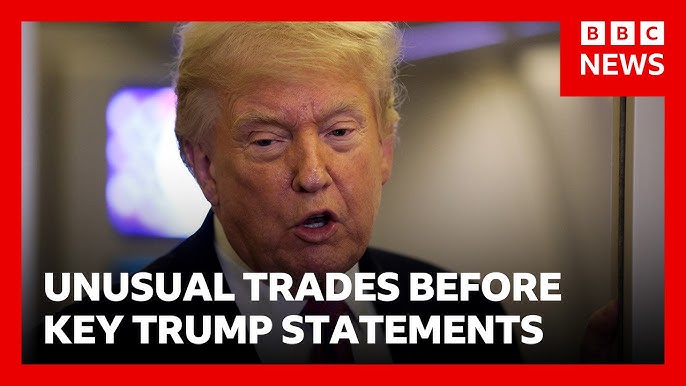
At 6:49 a.m. Eastern time, the very unusual happened. According to data compiled by Bloomberg, contracts corresponding to at least six million barrels of Brent and West Texas Intermediate crude oil were sold in two minutes, with a notional value of $580 million. For perspective, the average over the previous five trading days had been roughly 700 contracts in that same period, for about 700,000 barrels. The positions were structured to profit specifically from a simultaneous fall in oil prices and rise in stock markets.
The trading “was especially bizarre because there were no major news items—no major publicly available news items—to drive sudden big market transactions,” wrote economist Paul Krugman on March 24.
At 7:05 a.m., 16 minutes after the trades were placed, President Trump posted on Truth Social that the U.S. and Iran had held “very good and productive conversations” about ending hostilities, and that he was halting planned strikes on Iranian power plants and energy infrastructure. It was a sudden, sharp reversal from a post two days earlier in which Trump had threatened to “obliterate” those same plants.
Oil prices fell more than 10 percent within minutes. The Dow Jones Industrial Average surged more than 1,000 points. Whoever placed those trades had been on exactly the right side of both moves at exactly the right time. Former commodities trader David Kovel, now a New York lawyer representing fraud victims, gave 60 Minutes his estimate of the profit: “Tens of millions, could be $80 million.”
Stephen Piepgrass, a partner specializing in futures trading at the law firm Troutman Pepper Locke, told CBS News the trading volume “is certainly enough to raise eyebrows, and I think to launch an investigation into what was behind that.”
American history is littered with moments when public power quietly slid into private profit, especially during wartime. We know from history that when the country is under strain, someone close to power always seems to find a way to turn crisis into cash.
We know the practice of making shoes for soldiers in the Civil War was one such glaring example. It was so pervasive that Harper’s Weekly coined the term “shoddy aristocracy” or “shoddocracy” to define these unsavory businesspeople. Another classic example is the Teapot Dome scandal of the 1920s. Interior Secretary Albert Fall secretly leased federal oil reserves to private companies in exchange for personal loans and gifts. The Senate investigation revealed that Fall had effectively monetized national energy security for private gain. The Supreme Court later voided the leases, and Fall became the first U.S. cabinet official to go to prison.
Most of my readers surely recall during the Iraq War, when Vice President Dick Cheney’s former company, Halliburton, received billions in no‑bid contracts for wartime logistics. While Cheney had divested from the company, he continued to receive deferred compensation payments during his vice presidency. His profits tied to wartime decisions undermined public trust.
Congress itself has repeatedly faced accusations of insider trading, and it is an issue that absolutely needs to be curtailed and stopped. In 2011, a 60 Minutes investigation reported that several members of Congress made well‑timed stock trades during the 2008 financial crisis after receiving closed‑door briefings. This reporting by the then-proud news program helped spur the passage of the STOCK Act of 2012, which explicitly banned lawmakers from using nonpublic information for personal financial gain.
Today, deep concerns about individuals close to Trump profiting on oil stocks or benefiting from privileged information are in the headlines. For example, The New York Times and Bloomberg have reported about instances when Trump‑aligned investors made large, well‑timed energy‑sector trades during periods of geopolitical tension. I repeat that when those near power profit from crisis‑driven market swings, the public must question whether national decisions are being shaped by national interest or by private portfolios of the Trump family and their cronies.
Time and again during the war that Trump started against Iran, I have asked–along with my fellow citizens–whether military action or diplomatic tries were influenced by the prospect of profit. I take no glee in writing that suspicion, as I am disconcerted by the continuing erosion of trust in our public institutions. At this time, when facts prove that trades are taking place in wartime for personal profits, with the likelihood of insider information being shared making that possible, we must demand a bottom line of strict ethics and laws.
Ones that even the Trump Administration cannot flout.


Leave a comment