

Allen Drury has been a part of my life since the middle school years. As a teenager, his books, which were filled with political drama, remained a source of amusement as his series involved a wide array of colorful and at times incendiary characters. As a young adult, I remained a faithful reader of his stories about politics, law, and current events. I admired this eclectic and dapper man, who I would learn was gay. That connection meant a lot to me, coming from a rural conservative dot in Wisconsin when, as a high school student, I knew I was also gay. His erudite style and toss of the head in a sure-footed way was not lost on me.

I was elated to learn that Drury is in my family tree, on my dad’s (Royce Humphrey) side. For me, this is truly a grand find. My husband, James, does extensive genealogy, and when he rushed into the room to locate me with the news, I was grinning widely. I instantly thought of one person I would share this news with if it were possible.
These decades later, an incident that occurred in my small rural Hancock school still rankles as it smacks of small-town thinking.
“Do your parents know you are reading this book?”

That question from Mrs. Tunks, a middle school teacher of mine, was as close as book censorship ever came my way. I still recall the stair steps in the old schoolhouse where she pointed at my copy of The Throne Of Saturn by Drury, and while looking at it, sounded a prudish alarm, though for what reason I could never understand. Other than the fact that it was 600 pages, and ‘kids’ were not supposed to read anything other than the Nancy Drew or Hardy Boys series, it provides no real explanation for her remark. My parents encouraged me to read, as it kept me interested in all sorts of things, and it kept me quiet. Though years later they would say, ‘of course I would work in radio broadcasting as all I did as a child was talk’. I could be, admittedly, a handful at times.
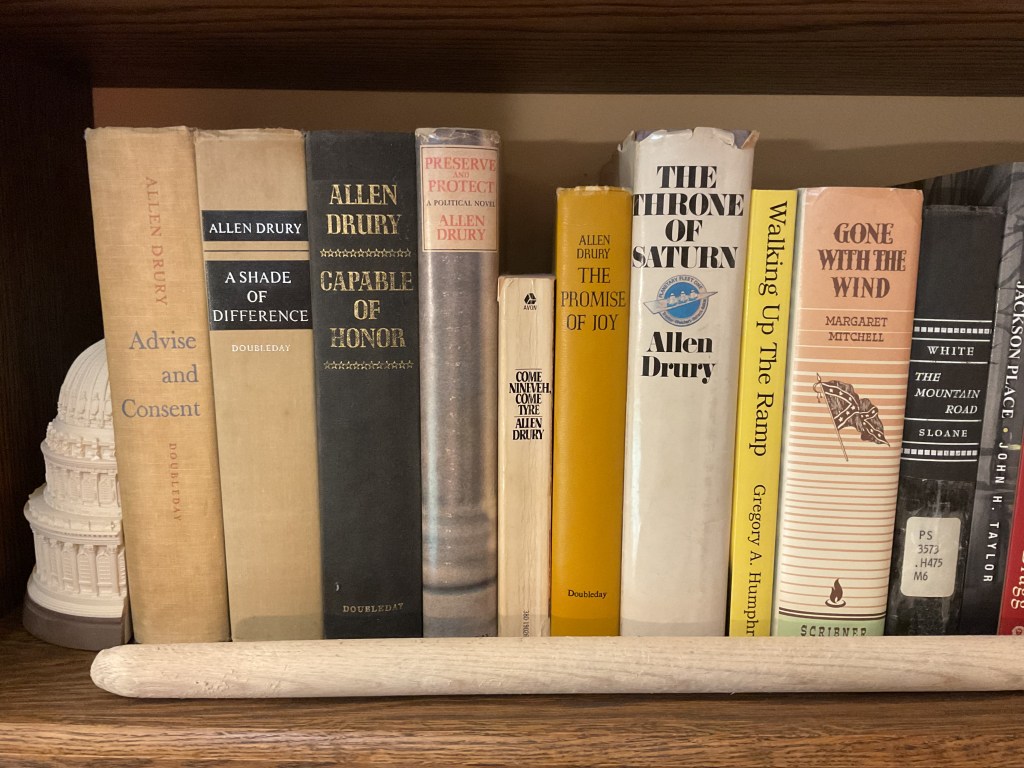
The teacher had a mighty skeptical mind as to why that book would intrigue me. A space adventure between the United States and the Soviet Union was high drama for my 6th-grade mind, and I guess for lots of adult readers as well, or it would never have been published. I finished that book, and today the hard copy edition sits on a bookshelf overlooking my desk where I write. It is not only a reminder of a good read but also to underscore a long-held belief of mine. No one should be censoring reading material for libraries, or, as in the case above, inquisitive minds.

In high school, I read Advise And Consent, which is a legendary book written in 1959 and a winner of the Pulitzer Prize for fiction. The book remained on the New York Times list for 102 weeks. The plot is built around a bitter Senate confirmation battle that takes a wild turn off the pages, which, in high school, I could not have predicted. A widely respected young senator is blackmailed over a homosexual affair in his past, prompting him to commit suicide in his Senate office. In later years, I would learn how this book interacted with our real-life politics and the way gay men and women dealt with being gay on the political stage. (That part of history is fascinating and infuriating at the same time.) The book truly had an impact on our society.
Drury used the real-life suicide of Democratic Senator Lester Hunt, who shot himself in his Senate office on June 19, 1954, as the focal point. Hunt wasn’t gay. But his son, Lester “Buddy” Hunt Jr., had been arrested the year before for soliciting gay sex in Lafayette Park across the street from the White House.
This famed photo from the 1960 race for president has John Kennedy and Richard Nixon on an airport tarmac with the book in hand amid conversation.


The reason the complete set of the Advise And Consent books is so rewarding to read for the first time, or again as we journey back over the decades in our recollections, is to remind ourselves of how government can operate. Through the use of multi-dimensional characters and real-world knowledge, Drury constructed political chaos, but also allows for the art of compromise and goodwill among partisans to rise up and match the needs of the nation. Sadly, reading about fictional characters in books now may be the only way to find common ground in Washington.
The process of governing is presented in a real-world, vivid way as the players move about Congress, the White House, and the diplomatic corridors at the United Nations. If anyone wants a civics lesson with expressive rhetoric and flair, it can be found in the Advise and Consent series. I am proud of them on my shelves.


Leave a Reply