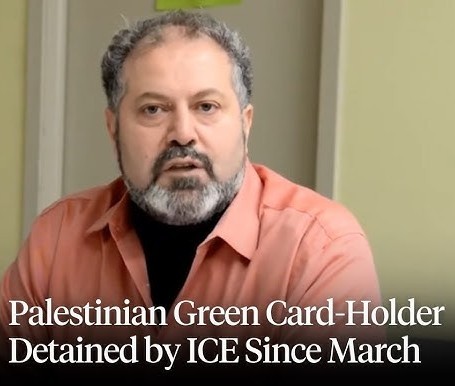
Wisconsin Senator Tammy Baldwin stated it best when reflecting on the internment of Salah Sarsour, president of Wisconsin’s largest mosque, and a legal permanent resident now held by the federal government.
Our nation’s founders realized that democracy cannot exist in a nation with a government that restricts or limits the speech and expression of its people. The Constitution protects an individual’s right to express their political views and have their voices heard. We condemn any attempts by this Administration to use the power of the United States government to unfairly target and punish people for simply disagreeing with it.
Let me provide a quick overview of the situation that is now playing out. Sarsour was born in the West Bank and settled in Milwaukee more than three decades ago after a stint behind bars as a teenager in Israel, became a business owner, and is very much a part of the social and spiritual fabric of Milwaukee’s Muslim community.
By 2026, the 53-year-old was in his fifth year as the board president of the largest mosque in Wisconsin and looking forward to the arrival of a tenth grandchild.
On the morning of March 30, Sarsour was picking up his mail on his way to work when an unmarked car sped toward him and a man with a gun got out, pointed the weapon at him and demanded he identify himself, according to an April 13 petition for his release. Nearly a dozen cars carrying plainclothes federal officers arrived moments later.
The officers from U.S. Immigration and Customs Enforcement took Sarsour from Milwaukee to the notorious processing center in west suburban Broadview. He was only at Broadview for a few hours before he was transferred to a jail in Clay County, Indiana.
Court filings on Sarsour’s behalf draw extensive parallels between Sarsour and other high-profile cases like that of Madawi and Khalil, the former Columbia graduate student who was one of the most visible faces of the school’s encampment protesting Israel’s war in Gaza.
Rather than being part of routine immigration enforcement, the attorneys wrote, Sarsour’s detention is “an extraordinary abuse of his constitutional rights and part of an extraordinary policy attacking First Amendment freedoms” and “the product of a documented, coordinated multi-agency campaign being waged by the government against Palestinians and advocates for Palestinian human rights.”
In our nation, as we near the Fourth of July, many people think about or hear and read about the values and ideals our nation treasures. Due process, equal protection, freedom of conscience, and the right to advocate for justice without being treated as a national security threat for one’s ethnicity, religion, or political commitments. So, what is happening regarding Sarsour, I argue, must be seen as more than the fate of one man. This is a test of whether our constitutional promises are real or merely performative and decorative.
Either we believe in the rule of law. Or we don’t.
For weeks, as Gaza was being viciously attacked, we flew the Palestinian flag at our home. Of all the flags we have flown over the years, none matched the number of bikers and walkers who said thank you or gave us a thumbs-up as they cruised along. As such, I have a strong gut reaction to the Trump Administration’s criminalization of Palestinian identity and the weaponization of political speech about the Middle East. In our country that prides itself on pluralism, it should not be controversial to say that standing with Palestinians in their struggle for dignity and human rights is a most legitimate political position.
Civics and history classes taught by James Winn and Marge Glad in my high school years (I took every course they taught on a bevy of related topics) allow me to say that our American values are not abstract slogans. They are not suggestions. They are obligations. They require us to defend the rights of people we may not know personally, whose politics we may not share, whose stories may be unfamiliar. They require us to reject the idea that the government can detain someone simply because their activism makes the powerful uncomfortable. They require us to insist that the law apply evenly, not according to the shifting winds of foreign policy or the prejudices of the moment.
Look, if we allow partisan fears to dictate whose rights matter, then the entire architecture of liberty becomes conditional, and conditional liberty is no liberty at all. If the government can target a respected community leader for his political commitments, then no one’s rights are secure. Maybe not even mine for flying the Palestinian flag.


Leave a Reply