
The Waushara Argus, my home county newspaper when I was growing up, continues to be delivered to my mailbox each week, these decades later. Like newspapers across the nation, these publications face economic pressures. But it is the self-imposed problems they create for themselves that often strike me as odd. The one that concerns me most is what was again posted in this week’s edition of the Argus.
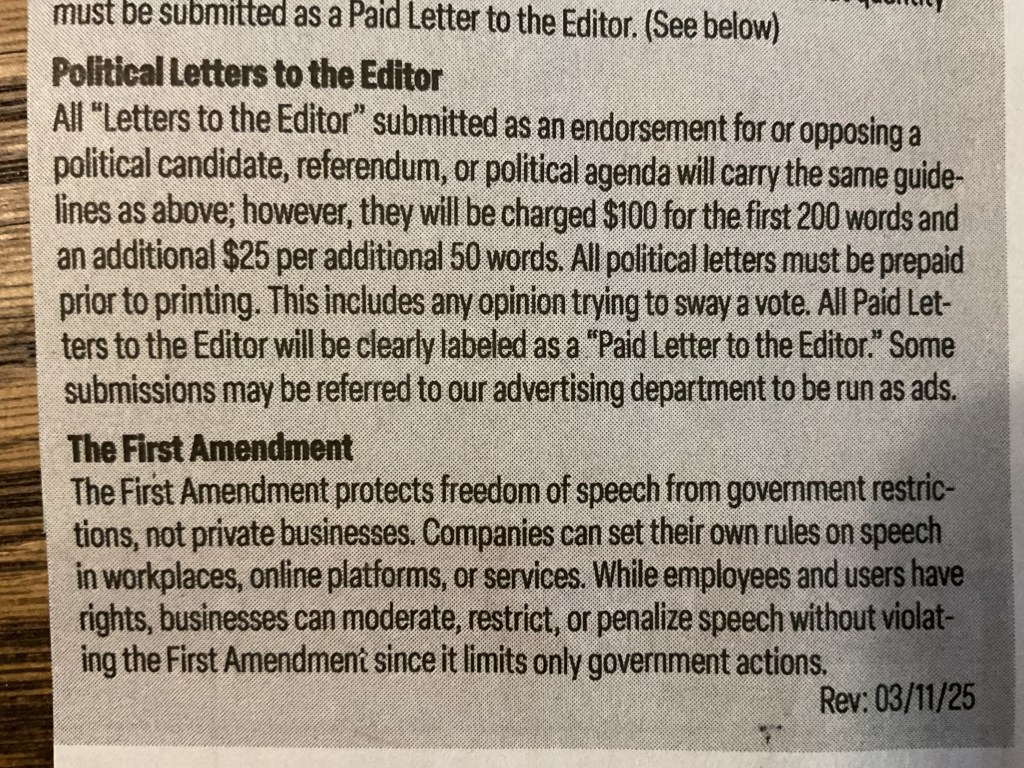
This newspaper decided that the best way to honor America’s long tradition of free expression as we head towards our semiquincentennial is to stop letting people freely express anything even remotely political or controversial. Perhaps Wautoma restaurants will announce soon that they will continue serving dinner, just not food. Yes, the newspaper’s stance is that absurd.
The new policy from this paper is jarring. Henceforth, they will no longer publish letters to the editor about a political candidate or official, a controversial policy issue, or a local referendum without the high price of $100 for the first 200 words and $25 per additional 50 words. What galls any lover of Constitutional rights is the prim, finger‑wagging explanation that “the First Amendment protects freedom of speech from government restrictions, not private businesses.” Talk about a statement that is legally correct and civically tone‑deaf in equal measure. It’s the editorial equivalent of telling guests, “Of course you’re welcome here,” while quietly locking the front door.
Newspapers have spent centuries marketing themselves as the public square, the civic hearth, the place where the citizenry could talk back. The letters page was the one democratic institution where a retired teacher, a cranky farmer, and a college sophomore hopped up on political theory could all share the same column inches. It was messy, it was loud, it was occasionally unhinged. It was American discourse.
For the Argus to declare that the public may speak, just not about anything that matters, is not neutrality. It’s abdication. It’s a newspaper deciding that democracy is simply too exhausting to host this year. You know, during the semiquincentennial and the midterms, and during the continued assault on our democratic foundations and values.
And the justification that the First Amendment doesn’t apply to them as a newspaper business is purposefully missing a much larger point. In no way am I accusing the Argus of violating the Constitution. I am accusing the Argus of violating its own heritage. The First Amendment is not just a legal shield; it’s a cultural inheritance. It’s the idea that debate, dissent, and even the occasional all‑caps rant are part of the American bloodstream. Newspapers helped build that tradition. Now the Argus is acting like landlords who suddenly resent the tenants.
If the concern is misinformation, then edit letters and state why. If the concern is civility, then enforce standards. (Like a wide array of newspapers across the nation does with every single publication.) If the concern is space, then maybe delete what is obviously filler material to make the paper look like it has news coverage. Or, expand online as the Argus has such a site. But banning political letters altogether is the editorial equivalent of mass censorship.
Here is my bottom line, as a decades-long newspaper reader and subscriber to three state or national newspapers. You can’t champion civic engagement while muzzling the civics. You can’t claim to be a forum while padlocking the presses. And you certainly can’t hide behind the First Amendment while ignoring the broader democratic tradition that made newspapers matter in the first place.

 Caffeinated Politics
Leave a comment