
Book juggling is one of my talents honed over the decades. There is a pile of books that I am currently reading, and I dive into a chapter or two today of this book and tomorrow, another book for a chapter or two, until they are finished. I have too many interests to dedicate myself to one book cover to cover, one at a time, and since history books are not difficult to track as to what is occurring since the last chapter was enjoyed, all is good. As such, I must rave just a bit about a book that I would strongly recommend.
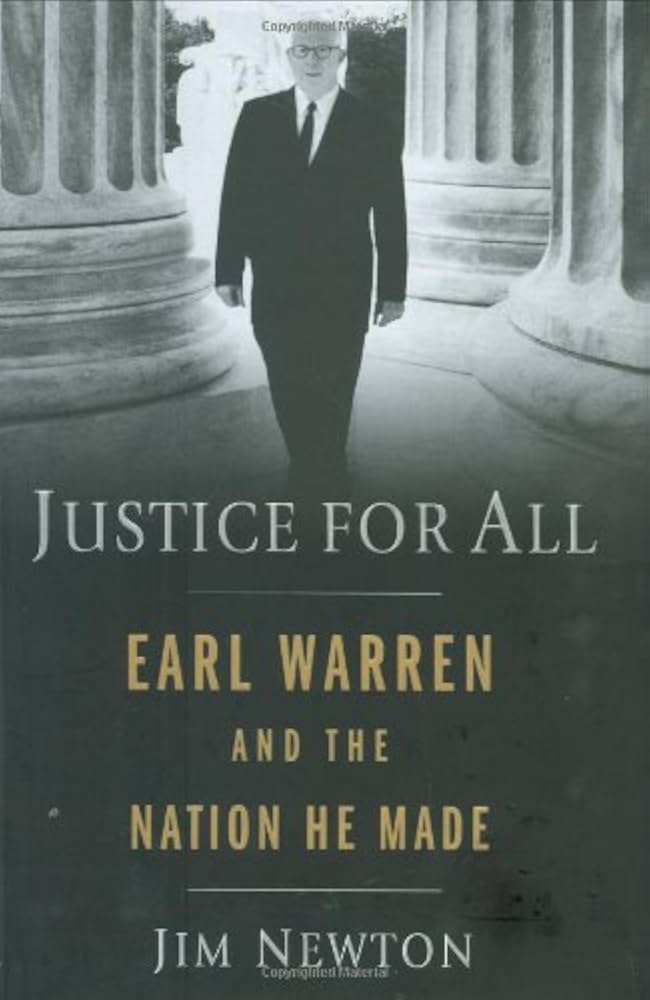
Earl Warren occupies that rare space in American history where a public figure not only held power but used it to enlarge the nation’s moral imagination. Think how rare that can be said over the past 50 years.
Historians like Jim Newton, in Justice for All, make clear that Warren’s leadership style was not bombastic or theatrical, but instead was steady, humane, and grounded in a belief that the Constitution should serve the people who actually live under it. Newton describes Warren’s approach to Brown v. Board of Education as a masterclass in quiet persuasion, noting how he worked behind the scenes to secure a unanimous ruling. That unanimity mattered. Warren understood that segregation would not crumble if the Court spoke with hesitation or division. His insistence on a single voice gave the decision the moral force it needed to confront a century of Jim Crow.
The Warren Court’s criminal‑justice revolution has been chronicled in Anthony Lewis’s Gideon’s Trumpet, which shows Warren’s belief that rights are meaningless unless they apply to the powerless. The book follows Clarence Gideon, a poor man who had no lawyer and no chance, until Warren’s Court declared that the promise of counsel must be more than a privilege for the wealthy. The same spirit animated Miranda v. Arizona, where Warren insisted that the government must play fair when it takes someone’s liberty. Critics called these decisions soft. Warren called them constitutional. And history has largely agreed with him. (Justice Thomas does not count as a historian for how he sneers at legal history.)
I grew up reading and understanding that the Warren Court was the moment when the judiciary finally stepped into its constitutional role with confidence. Warren’s decisions confronted racial injustice, expanded civil liberties, and insisted that democratic institutions serve the public rather than the entrenched few. Those views are amplified in this powerful book by Newton. To the conservatives who prefer caveman thinking, let me add that Warren did not radicalize the Court. He simply reminded everyone that the Constitution was written for people, not for the convenience of those already in power. OUCH!
My final thought as an overview is that Warren was a leader who understood that the law is not a museum piece but a living promise. Our Constitution is a living document, as I often state in my writings. He made the Constitution breathe life for an ever-changing culture and society.
Read the book.


Leave a Reply