
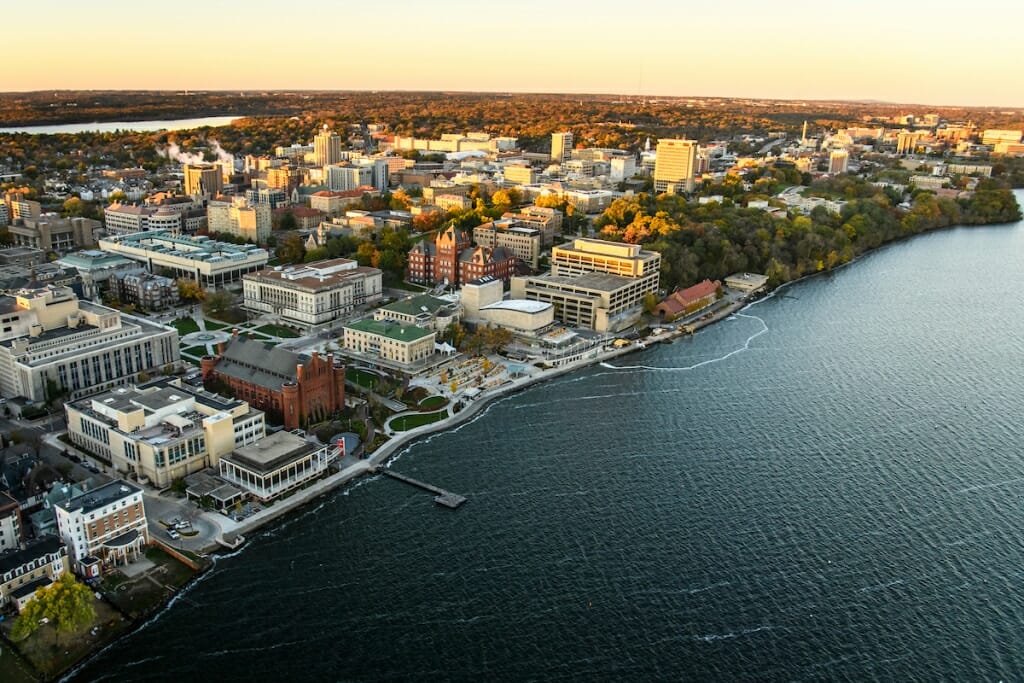
There is every reason the University of Wisconsin-Madison and our city can burst with pride. This weekend, with summer-like weather in October, a next-door neighbor invited us to a large backyard cookout and fire pit event attended mostly by grad students and young professionals. With so many topics to discuss, I noticed everyone was elated that the 2026 Nobel Prize in Physics went to UW-Madison professor Francis Halze.
It was clear these young people strive hard in their fields, and I suspect they sometimes wonder whether the punishing hours and technical work will ever pay off. So, when this Nobel Prize was announced, it vindicated not only all the years of work Halze and his team undertook but also gave a rush of energy to everyone pushing the envelope of learning and science.
As I watched people and heard what they had to say at the outing, I felt humbled and again supremely proud to be living in Madison. Over the past days, the world looked at the campus beside Lake Mendota and better understood who we are.
For generations, UW-Madison has drawn curious minds from around the world while upholding The Wisconsin Idea. At the heart of it is the belief that research and learning should benefit people beyond campus boundaries. In a very real sense, the path that led to this Nobel Prize began with that commitment to asking big questions and pursuing answers even when success seemed unlikely.
What makes Halzen’s story especially remarkable is just how improbable it was. Decades ago, building a telescope in Antarctic ice sounded more like science fiction than conventional science. Yet Halzen envisioned using the vast South Pole ice sheet as a detector to track elusive particles known as neutrinos, sometimes called “ghost particles” because they pass through ordinary matter almost undisturbed. That idea eventually became the IceCube Neutrino Observatory, a massive scientific instrument embedded deep within Antarctic ice.
Yet another all-important lesson must be understood. As I talked, ate, and watched the flames lick up the slabs of wood in the fire pit, I looked around at our friends and the new faces we were just meeting. From nuclear fission to T-cell research, these men and women know great discoveries rarely emerge overnight. They require patience measured in years and sometimes decades. But they also offer a lesson for you and me. That research requires higher-learning institutions willing to support ambitious ideas before the results are obvious. The research also requires public investment with our taxes.
In an era when universities are often criticized for small-minded partisan aims, this Nobel Prize achievement powerfully reminds everyone what institutions of higher learning can accomplish. Research conducted for the sake of knowledge can produce extraordinary benefits no one can fully predict.
Gosh yes, the UW-Madison and the city can be mighty proud. As a woman from the Fox Valley told me, not bad for a city on a Wisconsin isthmus!


Leave a Reply