
There is something special about accidentally rediscovering a memory that holds a cherished place in our lives. We spend much of our lives seeking new things and new experiences, and that is a grand way to live. But on the flip side, some of the greatest pleasures wait quietly for us to find them. Again. Like an old book on a shelf in a store.
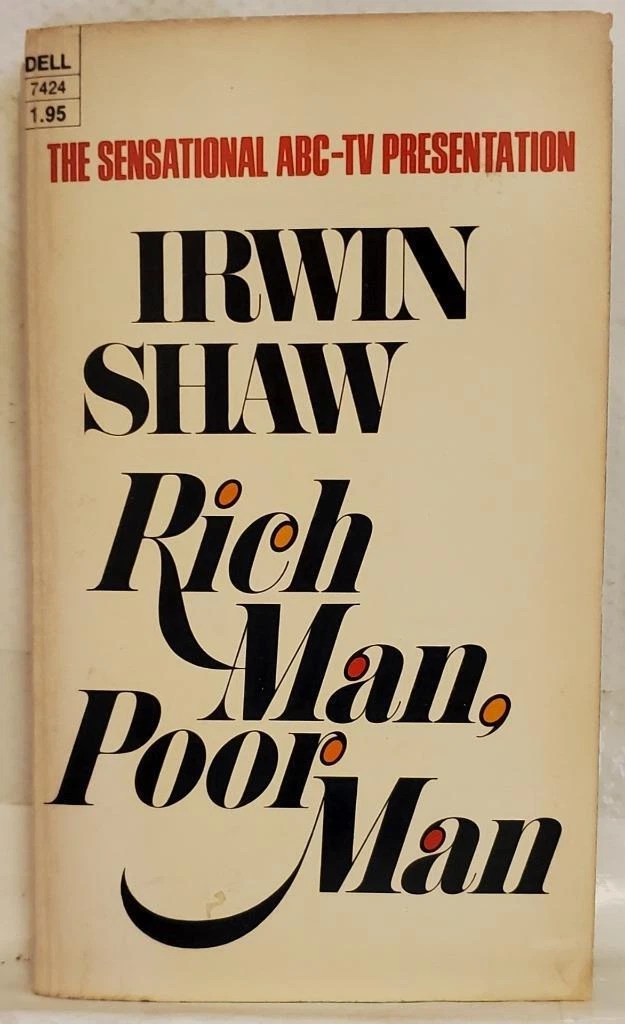
That happened to me two weeks ago while wandering through a used bookstore. I was not looking for any particular title. In fact, I was simply browsing like a lover, drifting from shelf to shelf, hoping something unexpected might call my name. Then it happened. There, nestled among dozens of forgotten paperbacks, was a worn Dell edition of Irwin Shaw’s Rich Man, Poor Man. The yellowed paperback pages stopped me in my tracks.
The orginal cover price read $1.95. What made me smile was that this 1970 Dell paperback, published nearly six decades ago, was still offered for exactly $1.95 today. In an era when even a cup of coffee seems to cost more every year, that little price tag felt delightfully absurd and comforting, surviving unchanged through wars, elections, recessions, technological revolutions, and entire generations. I picked it up, turned it over in my hands, and instantly knew I was taking it home.
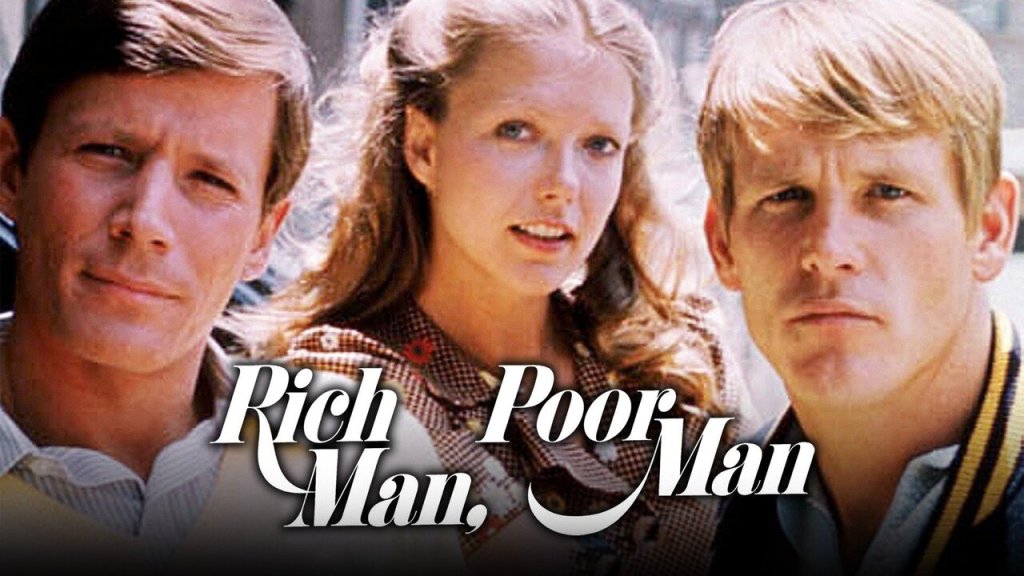
For those of us of a certain age (I have reached the point in life where I can write that phrase), Rich Man, Poor Man is more than a novel. It is entwined with memory. In 1976, when I was a high school freshman, ABC turned the book into a television miniseries that captivated millions of Americans. I hadn’t read the book, and I’d never heard of the author. But I was drawn in by the presentation, the plot, and the night-after-night drama. My mom watched some of it, dad watched none of it. I, however, was hooked.
I recall being engrossed in the Jordache family’s drama and swept away by a narrative that felt larger than my life in rural Hancock. It remains one of my favorite television memories from that era. But I must say, visiting the novel itself has been an even richer experience.
Perhaps the seasons have conspired to create the perfect setting. Wisconsin has been blessed with a succession of brilliant 70-degree days, that fleeting and almost mystical interlude we affectionately call Indian summer. (A biker today yelled from our street while passing, “These are the days to take it all in.”) The trees continue to surrender their leaves; the sunlight arrives with a golden softness; only the lightest breezes blow. We all know we are headed to late fall and the norms of Wisconsin.
So, I sat in an Adirondack chair and read. As I have for a portion of each of these gorgeous afternoons. The book is 666 pages, and I don’t think it could be published today because of its length and the way the story developed, with deep background on its characters. And the step-by-step plot development. Reading audiences have changed in 60 years, and publishers have too. (I don’t think I have, as I am in love with this book.)
With a cup of coffee, (always) the pages turn slowly. There is no urgency. No notifications from any social gadget distract me from Shaw. Today I thought about how serendipitous all this is. A chance discovery in a bookstore, when I wasn’t looking for anything specific. But then I stumbled upon a literary time capsule that transported me decades into my past, to when I was a teenager. With every chapter, memories returned. Not just memories of the story, but of the person I was when I first encountered it, and the world as it existed then.
Books have a wonderful way of doing that. They are not simply stories. They are vessels of sorts that sail in all directions. As I wrote at the beginning, people are always hunting for the newest (whatever), yet sometimes the greatest joy arrives in a used paperback for exactly $1.95.
It begs the question of what it means to be rich.


Leave a Reply