
For many months, I have had a photo from a 1934 Saturday Evening Post in my ‘to do’ pile, as I wanted to add some commentary on the painting’s innocence and place it in context with our helicopter censors, who would deem this unacceptable on a cover of a best-selling magazine today. Somehow, it would be argued, children were being viewed in an unsavory light. With a rainy Friday and good coffee last week, I finished my column that was started when snow still gripped our front lawn. Yes, some posts get worked on and then slip off the radar for a time. That is why a rainy day is always welcomed in my world.
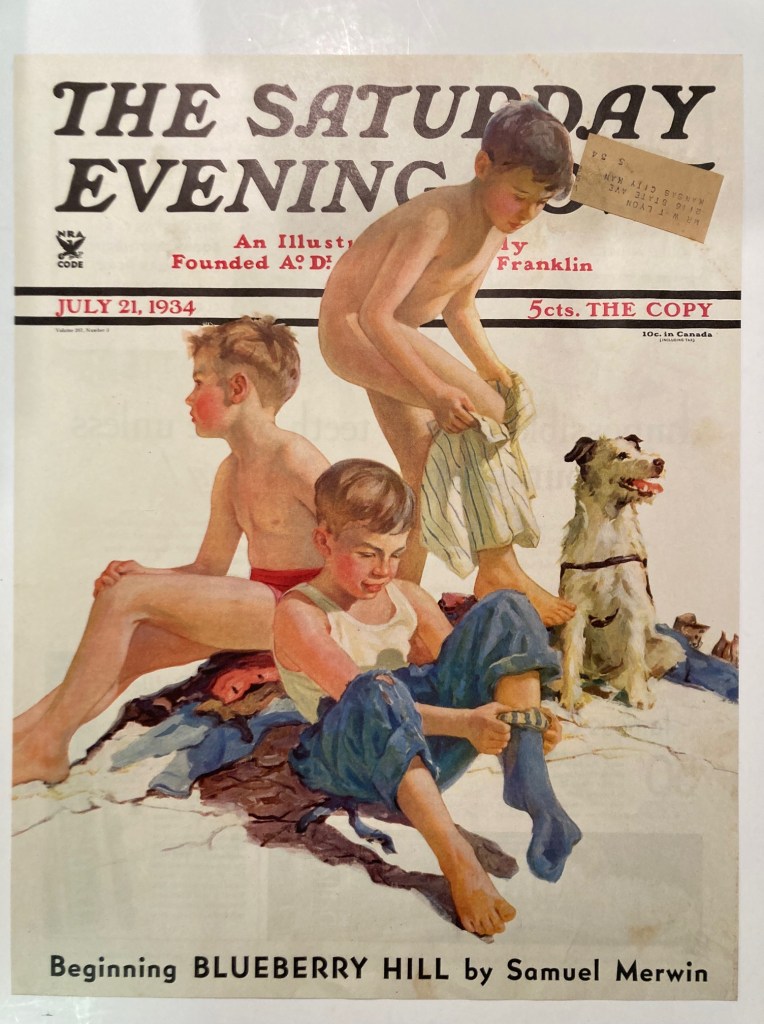
There is a particular kind of American innocence that once lived comfortably on the cover of The Saturday Evening Post, and nowhere more clearly than on July 21, 1934, when Eugene Iverd’s trio of sun‑warmed boys appeared on newsstands across the country. They sit on a rocky shoreline, half dressed, half drying, with a dog standing guard. It is simply boyhood in its natural state, unbothered, unmonitored, and unburdened by adult anxieties. The camaraderie is effortless, the innocence unforced, and the moment, in the way it is presented, so ordinary that it becomes extraordinary. Especially when viewed from the perspective of 2026.
In 1934, a painting of boys changing after a swim was just that, a painting of boys changing after a swim. It wasn’t a cultural flashpoint, a moral referendum, or a magnet for outrage from censors and would-be monitors of decent society. It was a slice of summer, a reminder that childhood is made of small freedoms and that boys on a shoreline are not symbols of anything except the universal truth that kids deserve to be kids.
Today, we live in a country that can’t look at a depiction of children with a thigh showing without immediately scanning for harm, impropriety, or some imagined threat. Innocence has become something adults interrogate instead of recognizing. A simple image of kids at play becomes a battleground for cultural neuroses. We have become so conditioned to see danger everywhere that we’ve lost the ability to see childhood as fundamentally good and normal.
We were treated to the moronic twits on the Watertown School Board not allowing band students to perform an instrumental piece of music tied to LGBTQ+ history at their spring concert. The notes might lead boys to play with boys and girls to play with girls, and that can only lead to them learning to play pool. Cue up the songs from The Music Man.
The boys on that 1934 cover aren’t sexualized, politicized, or freighted with adult meaning. They aren’t performing innocence; they’re living it. They are the embodiment of a world that trusted children to inhabit their own space without dragging them into adult fears. It is simply the natural state of childhood when adults choose not to contaminate it.
And maybe that is the lesson the cover offers to 2026. Innocence is not a relic of the past. It is a cultural choice. It is the decision to let children exist without projecting adult anxieties onto them. The boys on the rocks were not complicated. They were simply boys, drying off after a swim, sharing a moment of uncomplicated friendship. Ninety‑two years later, (if my math is correct) the least we can do is recognize that same type of innocence when it appears and allow it to exist without apology.

 Caffeinated Politics
Leave a comment