

One continuing theme for nearly 20 years (July 2026) that has been a foundation of Caffeinated Politics is the awareness of why serious gun control measures are needed in our country. Over the decades, I have pressed that parents or guardians of children who commit gun crimes must be held accountable for allowing guns to be made available to those underage who reside in the home. When starting my postings about this matter, it felt like I was all alone. But no longer. Society and the law are now doing what had been urged on this blog.
The conviction of Colin Gray in Georgia today was not only appropriate but necessary. When a child in his home was able to access an AR‑15 and use it to kill two classmates and two teachers, the chain of responsibility did not begin with the young shooter—it began with the adults who allowed that weapon to be available in the first place. Guns do not simply migrate into children’s hands. They are left loaded, unsecured, and within reach. They are treated casually, as if they are no more dangerous than a household tool. And when that negligence leads to four people being gunned down in a school, accountability is not optional. It is the bare minimum.
During the trial, and with dramatic and harrowing testimony, several Georgia high school students testified in court about being shot during their algebra class. They recounted, through tears, seeing a classmate in a pool of blood, then seeing blood on their own bodies and fearing they might die.
Prosecutors accused Colin Gray of ignoring warning signs of his son’s potential violence and allowing him access to the high-capacity weapon.
Colin Gray, 55, was rightly found guilty of all charges, which included second-degree murder and cruelty to children, in connection with the September 4, 2024, mass shooting carried out by his son Colt Gray, at Apalachee High School. The jury deliberated for less than two hours before finding Gray guilty on all 27 charges.
By being worse than a negligent father, Colin Gray was a driving force behind the murders of four people who were murdered with a deadly gun from his home.

This tragedy was preventable. An AR‑15 is a weapon designed to kill quickly and efficiently, and when a child can pick one up and walk into a school with it, something is deeply broken.
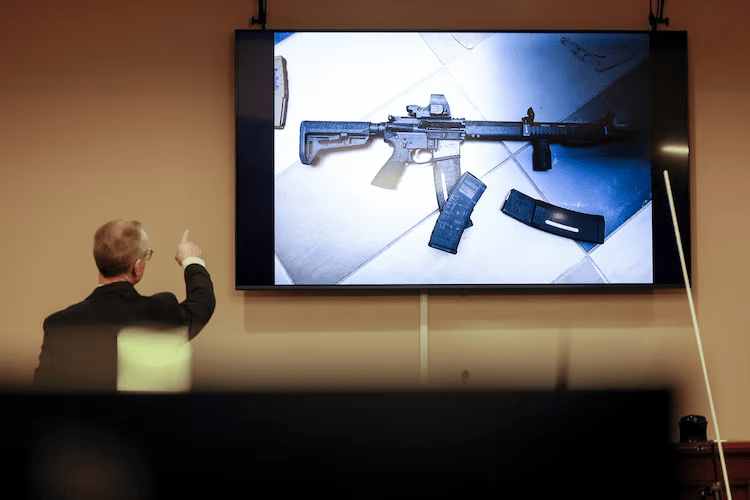
The AR-15 is in the hands of more civilians than any other rifle in America. Within this nation, it is estimated that there are over 20 million of them. It needs noting that in the rest of the world, they are rare except among government forces, criminal gangs, or some regulated hobbyist or security groups. That weapon of war has been used in the majority of U.S. mass shootings, which are most of the world’s mass shootings.
In the 1950s, it was invented by a renowned engineer and designer named Eugene Stoner, who was working for the Armalite corporation. In the early 1960s, the U.S. military took Stoner’s AR-15 design as the working basis for a new infantry rifle, which, after its military modifications, would be known as the M16.
Through the 1970s until the early 2000s, the AR-15 was on the civilian market but not a high-volume item. (The M16, like most military equipment, is not available to civilians.) In an Atlantic story last year, a former gun-industry official named Ryan Busse said that in those days, even within the industry, “assault rifles and tactical gear were [seen as] a creepy, fringe interest that had no place in a complex democratic society.”
In 2004, a Republican-controlled White House and Congress let a Clinton-era “assault weapon ban” lapse. Through that decade, AR-15 sales rapidly increased, and so did AR-15 massacres. Who could have predicted such an outcome?
Eugene Stoner was not around to see what had become of his weapon. He had died in 1997. But as the massacre rate increased, his family came forward to tell NBC News that Stoner himself never thought this rifle should be in civilian hands: “Our father, Eugene Stoner, designed the AR-15 and subsequent M-16 as a military weapon to give our soldiers an advantage,” the family said in 2016. “He died long before any mass shootings occurred. But, we do think he would have been horrified and sickened as anyone, if not more by these events.”
We have created a culture where firearms are treated as symbols of identity rather than instruments of lethal force. We have normalized the idea that “responsible gun ownership” is whatever the owner says it is (I call that pure bunk), even when the consequences are catastrophic. The result is a country where children die because adults refuse to take the simplest precautions.
Holding parents and guardians legally responsible is not about vengeance; it is about recognizing that children cannot access guns unless adults allow them to. When adults fail to secure their weapons, they make a choice that endangers everyone around them. Accountability reinforces that gun ownership carries obligations. It creates consequences for negligence. And it sends a message to every gun‑owning household that safety is not optional, not negotiable, and not something to be shrugged off.
We are losing far too many people to gun violence—children, teachers, neighbors, bystanders. These are not statistics; they are shattered families and traumatized communities. Every time another shooting happens, we ask how it could have been prevented, but we already know the answer. Guns are too easy to access. Safe storage is too often ignored. And we have allowed the idea of “rights” to overshadow the reality of responsibility. The result is a nation where shootings are so common that they barely shock us anymore, and that should horrify every one of us.
The conviction of Colin Gray will not bring back the four lives lost, but it does mark a turning point. It acknowledges that adults cannot escape responsibility when their weapons end up in the hands of children. It recognizes that the choices made inside a home can have deadly consequences outside of it. And it forces us to confront a truth we have avoided for too long: if we want fewer shootings, we must demand more from the adults who own guns.
It gives me no joy in seeing trend lines moving in the direction I advocated. After all, there are still dead people as a result of the murders guns create.


Leave a comment