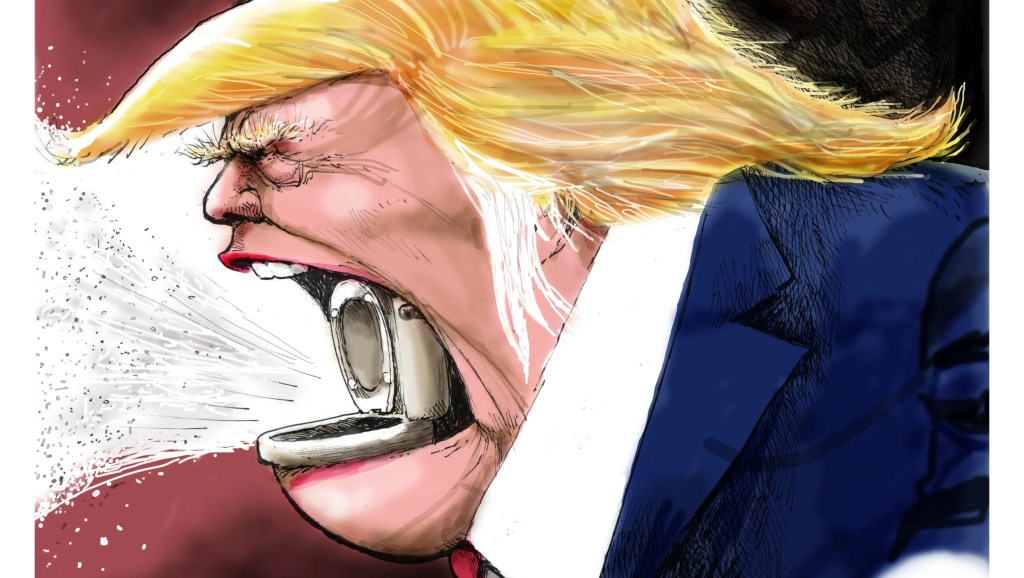
Not for the first time, I strongly criticize the coarse language coming from Donald Trump, who sits in the Oval Office. Over the years, I have repeatedly stated there is an entire dictionary of words to use rather than the F word and other foul choices. In a deranged social media post on Easter Sunday (of all days!) Trump was dark and horrifically crude. In addition to the low-brow word usage, his behavior runs counter to the tone and skill set we must demand of a president.
The post included the phrase: “Open the (expletive) Strait, you crazy (expletive), or you’ll be living in Hell – JUST WATCH!”
I thought about the loutish wording from Trump on this highly religious holiday weekend. His evangelical supporters assert he was chosen by God. Doing the Lord’s work if you listen to the messaging from the Christian right. As I read the words from Trump, it is clear to this observer of American politics that sermons from the right about moral purity issues relating to the culture wars they foment run into the wall of irony when Trump speaks like he wandered out of a late-night locker room. (Not that he was actually exercising!)) The acceptance of this weekend’s blending of religious holiness with the kind of language that would have once earned a child a bar of soap stuns me.
Granted, I grew up in a home and a community where standards were stressed. History was pressed as a way to understand who we are. So, I can write with clarity that there has never been a presidency in which language did not matter. We know that the words of our chief executive carry a particular gravity. Those words can calm markets or steady a frightened nation. When misused, as we have observed under Trump’s two terms, they can just as easily stoke division and fear. In high school, one of my history projects, which I learned so much from, revolved around how the moral authority of a president is conveyed through speech. I have stressed for decades the reasons why presidents choose precision, restraint, and dignity with their choice of words. All of that stands in such stark contrast with Trump’s coarse and inflammatory language on the national stage.
To underscore this issue, I want to briefly highlight how past presidents have wielded language during moments of national strain.
President Abraham Lincoln, in the midst of the Civil War, delivered his Second Inaugural Address with a tone of sorrow rather than triumph. Instead of gloating over battlefield victories, he spoke of binding the nation’s wounds “with malice toward none, with charity for all.” At a time when anger would have been easy, and I can argue perhaps politically useful, he chose moral clarity and restraint.
President Franklin D. Roosevelt, confronting the Great Depression, understood that panic could be as dangerous as economic collapse itself. His famous reassurance that “the only thing we have to fear is fear itself” was not just a slogan but rather a deliberate act of national stabilization. His fireside chats were crafted to be calm, plainspoken, and educational, helping millions understand complex policies without inflaming anxieties.
President John F. Kennedy, during the Cuban Missile Crisis, delivered an address that was firm but measured. He avoided incendiary language even as the world stood on the brink of nuclear war. His words were chosen to convey resolve without provoking escalation.
President Barack Obama, after the 2015 Charleston church shooting, spoke with a tone that blended grief, empathy, and reflection. His eulogy for Reverend Clementa Pinckney avoided political point‑scoring and instead appealed to the nation’s conscience. It was among the best national messages he offered.
These examples are not about political ideology. They are about an understanding shared across parties and centuries that the presidency demands a disciplined relationship with language.
I have no doubt that the lowest 30% of each high school graduating class across the nation, if they even heard this news of Trump’s crudeness, applaud it. But I argue that presidents have in the past, and should in the future, elevate the national conversation, not mirror its angriest and most benighted corners.
It is not difficult to grasp that when presidents speak with dignity, clarity, and restraint, they strengthen the civic fabric. When they do not, the fabric frays. I know the past teaches us that the words of a president are never just words. In an age of instant communication and heightened polarization, the responsibility to choose them wisely has never been greater. I only wish we had someone in the Oval Office with the acumen to understand it.


Leave a comment