
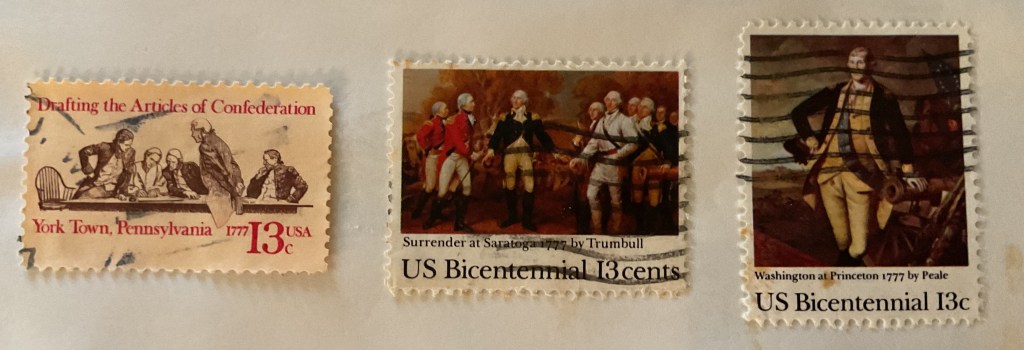
America is about to turn 250, and you wouldn’t know it unless you happened to trip over a press release from the city or county about a parade or upcoming fireworks displays. For a nation that once threw itself a year‑long Bicentennial bash — tall ships crowding New York Harbor, wagon trains converging on Valley Forge like a Norman Rockwell recreation — the silence today is deafening. And it is very sad as we prepare to observe the semiquincentennial.
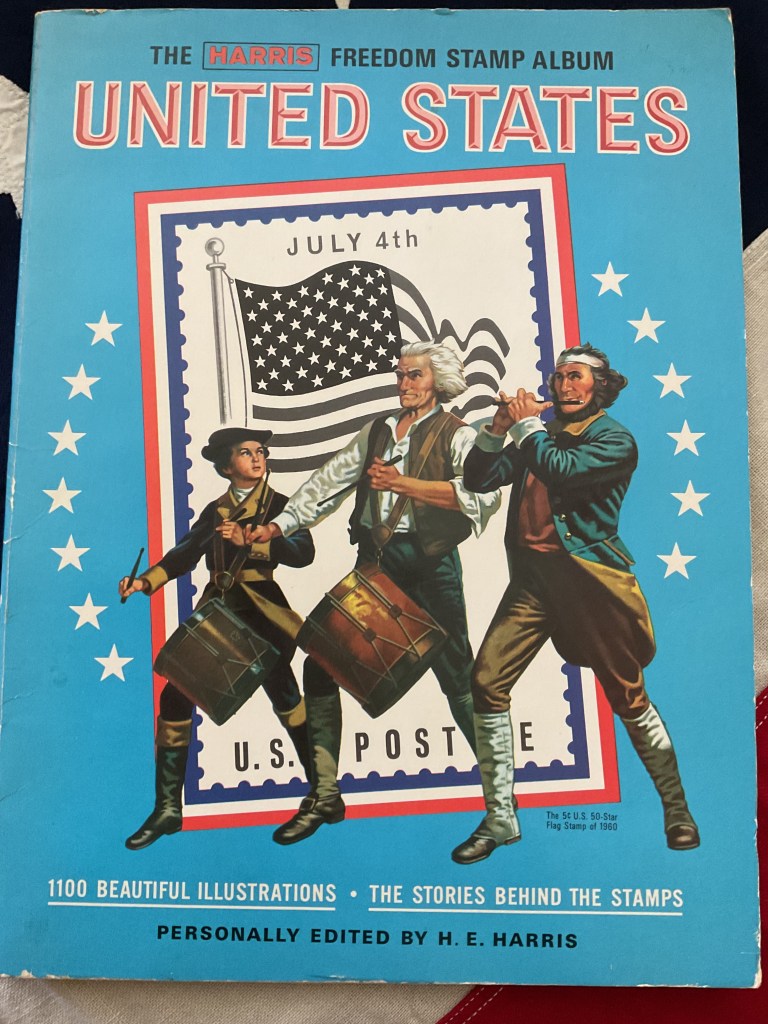
This past week, James and I walked back in time with a drawer full of items from our teenage years. While doing some reorganization, I rediscovered my souvenir photo album from a Glen Campbell concert in Wisconsin Rapids. Of course, there was my stamp collection, a pastime that consumed hours as a boy. The cover recalls the festive mood of our Bicentennial year.
I was so pumped with enthusiasm in 1976. At age 14, I was already reading history for fun and had a rather nice cassette tape recorder. I purchased some Maxwell tapes because the advertising was highly effective, even at my age. “Even after 500 plays, our high-fidelity tape still delivers high fidelity. It’s worth it.” After watching many months of the popular CBS nightly series, Bicentennial Minutes, the one-minute segment (8 P.M. CT), and already knowing I was fascinated by radio broadcasting, I started making my own recordings. I had no problem finding a way to celebrate our national birthday in rural Hancock.
Back in 1976, the country was coming off Vietnam, Watergate, and an oil crisis, yet somehow still managed to muster a truly hopeful patriotism. I was thrilled at the massive gathering of tall ships from around the world in New York Harbor, forming what would become one of the most iconic images of the Bicentennial. I recall saying (far too often, my parents surely thought) how we should be on the reconstructed pioneer wagon train from states across the country converging on Valley Forge for July 4, 1976. (Never mind the constant response that I had never slept outside overnight in my life.) Each of these celebratory events, and many more like them, surely were not perfect, but they were big, earnest, and collectively shared by the nation.
I recall President Gerald Ford lighting ceremonial lanterns at Old North Church, visiting Lexington & Concord. At times, being a history teacher as well as the national leader. Those scenes from our history books came alive again as Ford talked with the nation.
Fast‑forward fifty years, and the Semiquincentennial feels like a group project where everyone stopped replying to the email thread. Sad, I say. It goes without saying that our nation has not forgotten how to celebrate in 2026. Rather, we seem to have, however, forgotten how to celebrate together.
Part of the problem, as widely reported, is that the original national commission, formed a decade ago and charged with planning the 250th, fell into political crossfire. The bipartisan U.S. Semiquincentennial Commission was sidelined after the Trump administration launched its own organization, both to monetize it and place Trump at the center of the national birthday. When the planning body for our national birthday became a partisan tug‑of‑war, the result is exactly what we have now: confusion, fragmentation, and a whole lot of nothing.
And so here we are — a quarter‑millennium old, with no tall ships on the horizon, no wagon caravans warming up their coffee pot over an open flame as the sun lifts off the horizon. The tragedy isn’t just the absence of spectacle. It’s the absence of a story. Our story. The Bicentennial gave Americans a narrative about who we were and who we hoped to be. The 250th, so far, is giving us a shrug.
The Semiquincentennial has been a seriously missed opportunity. A reminder that a nation can only celebrate its birthday if it remembers how to be a nation in the first place.


Leave a Reply