
“Somehow the letters-to-the-editor page, strange and wonderful as it always is, is one of the chief adornments of the society we love and seek to clarify for the world. The privilege of writing to the editor is basic; the product is the hot dish of scrambled eggs that is America.”
— E. B. White, essayist and author
I received a very prompt response after submitting a Letter to the Editor at the Waushara Argus. I had included the paper’s owner in my email, given the troubling nature of the topic I was addressing. The Argus will no longer publish letters to the editor about a political candidate, a controversial policy issue, or a local referendum without the writer having to pay a hefty fee. I contend that this newspaper is violating its own heritage. Patrick Wood, CEO and Publisher of Multi Media Channels, wrote back with strong disagreement. Given that your letter is itself a critique of our internal editorial policy rather than a Waushara County community matter, we will not be running it. But the need for a sound journalistic newspaper is a need of the community.
In this column, I will present their policy, including both my letter and the owner’s response, as well as additional rationale for why this newspaper’s heritage is in question. I dare say I am among the top five letter writers for the number of letters published in the Argus over the last 50 years. As such, I feel most able to address the folly of this current policy.
Here is the Letter to the Editor I submitted on Friday, June 19th.
The Waushara Argus, my home county newspaper when I was growing up, continues to be delivered to my mailbox each week, these decades later. Like newspapers across the nation, these publications face economic pressures. But it is the self-imposed problems they create for themselves that often strike me as odd. The one that concerns me most is what was again posted in last week’s edition of the Argus.
This newspaper decided that the best way to honor America’s long tradition of free expression as we head towards our semiquincentennial is to stop letting people freely express anything even remotely political or controversial. Perhaps Wautoma restaurants will announce soon that they will continue serving dinner, just not food.
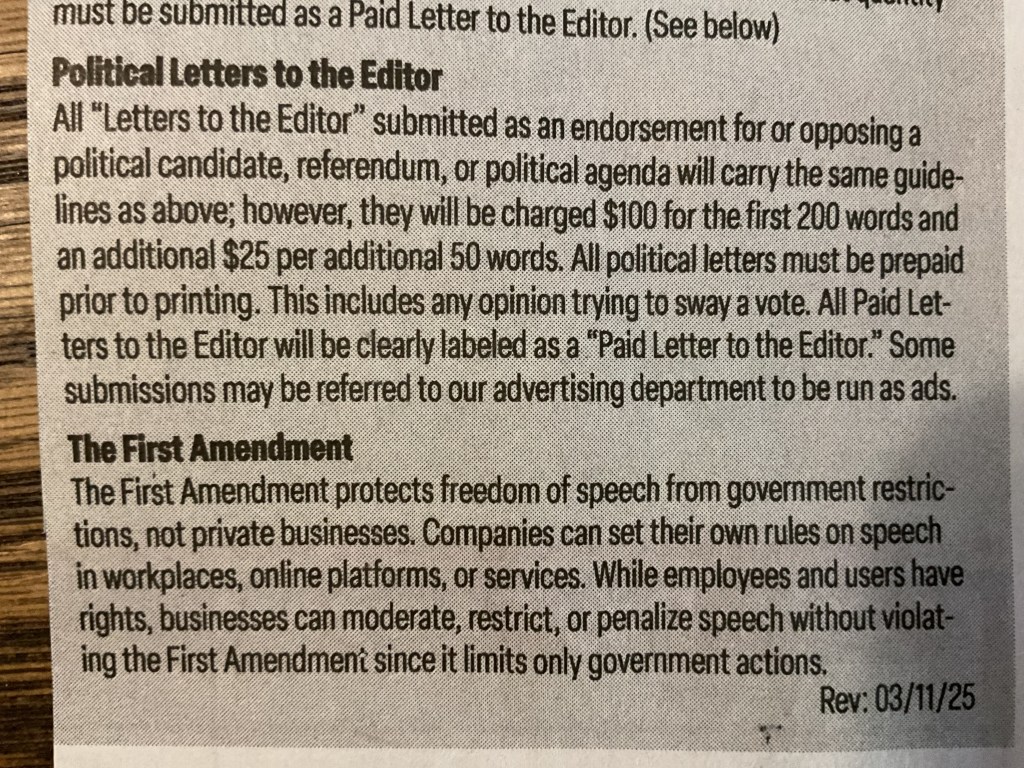
The policy from this paper is jarring. They will no longer publish letters to the editor about a political candidate or official, a controversial policy issue, or a local referendum without the high price of $100 for the first 200 words and $25 per additional 50 words. What galls any lover of Constitutional rights is the prim, finger‑wagging explanation that “the First Amendment protects freedom of speech from government restrictions, not private businesses.” Talk about a statement that is legally correct and civically tone‑deaf in equal measure.
Newspapers have spent centuries marketing themselves as the public square, the civic hearth, the place where the citizenry could talk back. The letters page was the one democratic institution where a retired teacher, a cranky farmer, and a college sophomore hopped up on political theory could all share the same column inches. It was messy, it was loud, it was occasionally unhinged. It was American discourse.
For the Argus to declare that the public may speak, just not about anything that matters, is not neutrality. It’s abdication. It’s a newspaper deciding that democracy is simply too exhausting to host this year. You know, during the semiquincentennial and the midterms, etc.
And the justification that the First Amendment doesn’t apply to them as a business is purposefully missing a much larger point. In no way am I accusing the Argus of violating the Constitution. I am accusing the Argus of violating its own heritage. The First Amendment is not just a legal shield; it’s a cultural inheritance. It’s the idea that debate, dissent, and even the occasional all‑caps rant are part of the American bloodstream. Newspapers helped build that tradition.
If the concern is misinformation, then edit letters and state why. If the concern is civility, then enforce standards. (Like a wide array of newspapers across the nation does with every single publication.) If the concern is space, then maybe delete what is obviously filler material to make the paper look like it has news coverage. Or expand online as the Argus has such a site. But banning political letters altogether is the editorial equivalent of mass censorship.
Here is my bottom line, as a decades-long newspaper reader and subscriber to three state or national newspapers, and the Argus. You can’t champion civic engagement while muzzling the civics. You can’t claim to be a forum while padlocking the presses. And you certainly can’t hide behind the First Amendment while ignoring the broader democratic tradition that made newspapers matter in the first place.
In just over an hour, a reply came, one I appreciated for its timeliness.
Dear Mr. Humphrey,
Thank you for taking the time to write. I read your letter in full, and since you copied me directly, I want to respond to you myself rather than leave the matter to staff.
The policy you object to is not an accident, and it is not a retreat from the First Amendment. It is a deliberate editorial choice, and the following should explain the thinking behind it rather than simply restate it.
The Waushara Argus exists to serve the community it covers. Our mission is to strengthen and inform that community: the schools, the local businesses, the township meetings, the people and events that make up daily life in Waushara County. That mission is why we are still in business after decades when so many community papers have closed. National politics and partisan controversy already have an enormous number of outlets fighting for attention: cable news, talk radio, social media, and national papers among them. A small weekly with limited pages does not need to compete on that turf, and choosing not to is not censorship. It is a decision about where our resources and our column inches do the most good for the readers we actually serve.
You wrote that you are not accusing us of violating the Constitution, only of violating our own heritage. I would push back on that framing as well. A newspaper deciding what it will and will not publish is not an abdication of its heritage. It is the heritage itself.
Editorial judgment, including the judgment to keep a letters page focused on local civic life rather than imported national arguments, is exactly what responsible editors have always exercised. We are not silencing anyone. We are choosing what kind of publication we want to be, which is a choice every paper is entitled to make and most readers, frankly, want us to make.
Given that your letter is itself a critique of our internal editorial policy rather than a Waushara County community matter, we will not be running it. I would encourage you to direct this argument toward the broader debate happening elsewhere about the role of local papers, including in the state and national publications you already subscribe to. Those are the right venues for this conversation. The Argus will continue doing what it has always done: serving its own readers and its own community.
Thank you again for writing.
Sincerely,
Patrick J. Wood
CEO and Publisher
At the outset, I come to this issue as a lifetime reader of newspapers. Growing up without television but with access to a daily newspaper (Stevens Point Journal) in our rural Hancock home provided me with a foundation that still governs my days 63 years later. These publications matter both in my daily use and in their historical importance. While Multi Media Channels have business interests to evaluate continuously alongside bottom-line concerns (nothing wrong with profits), my perspective on newspapers is on the value they provide in informing and educating the citizenry. The impact they create among the electorate. Part of that democratic process involves newspapers publishing letters to the editor on a bevy of news topics.
About fifty years ago, as a teenager, I wrote my first letter to the editor of the Argus. Gun deaths from senseless shootings were on the rise, and I wrote about United States v. Miller, which ruled that the government can heavily regulate certain firearms. I wrote about what the local community might do to provide more outlets for youth and a better array of needed activities. I wrote a letter defending the Waushara County judge in the Ed Gein murder trial for having written and published a book from his perspective. I wrote about the church of my youth in Hancock, starting a religious school, and how that was an attempt to short-circuit a child’s need for a broader education. I wrote with strong approval about the Argus publishing the wedding announcement of two gay men. And I wrote about the need for free trade in 2016.
The anti-trade rhetoric was so loud from various campaigns during the primaries that facts were supplanted with emotional populism run amok. I would like to see candidates who wish to show leadership qualities make the election as much an education on the issues as hunting for votes.
In high school, I was involved in the Library Club and enjoyed using the newspaper hanger. These spindle-like devices consisted of a long wooden mechanism down the center. To use it, I would open the stick, slide the newspaper’s center section down, and secure it. From those papers, I came to read stories reported in other papers by men I would come to know and much admire, such as Jack Germond and Jules Witcover. They were part of the iconic group known as ‘The Boys on the Bus’, which influenced the way I did my work as a radio broadcaster and news reporter. Again and again over the decades, newspapers and reporters have had a significant impact on my life.
I believe that Wood left the train track in his response to me when failing to understand that when a paper stops accepting letters to the editor, the loss is structural. Those letters show what a community is actually thinking, not what its institutions wish it were thinking. Power structures, especially in rural areas like Waushara County, like to control information. Don’t talk about high-capacity wells and groundwater, or the high use of pesticides on farm crops. Or the merits of a school referendum. From a lack of adequate healthcare to a lack of affordable housing, it is so much easier to just not talk about the pressing problems. How about posting another photo of a cute kid eating a corn dog at a local festival?
(A number of years ago, when a new editor arrived at the Argus, I mailed a copy of a powerful book about editors from across the nation and throughout the span of our national story who used their positions from small towns to large cities to effect change via well-crafted editorials. My hopes for a stronger and more robust Argus are a long-term desire.)
So, when the Argus shrinks from its journalistic role in the community by ending, for all practical purposes, letters to the editor, communities and citizens lose a civic space for dialogue. The Argus seems pleased with deciding that the conversation will now be one‑way. As someone who has studied history, let me just write that democracies do not thrive on one‑way communication.
Finally, history is richer when we read research and narratives showing the history of civic emotion. From the colonial broadsheets that printed citizen essays under pseudonyms (ratification of the Constitution), to the abolitionist papers that published letters from readers risking their lives, to the small‑town weeklies where neighbors debated zoning, taxes, and school policy, newspapers have always been a forum for such discussions. If the people’s voices, ranging from their anger, their fear, their hope, and their confusion, are not included in the historical narrative, only the official voices will be known.
Unless they had $100 for the first 200 words and $25 per additional 50 words.

 Caffeinated Politics
Leave a comment