
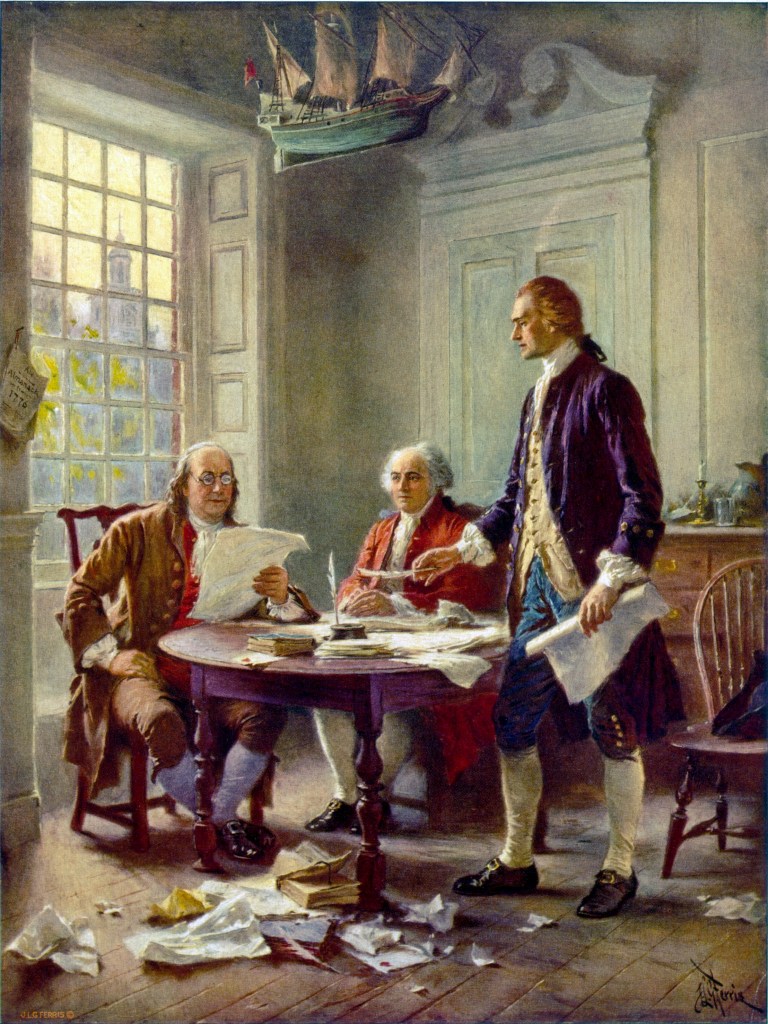
Every year as July 4th approaches, I find myself reading a new (or new to me) book that was set aside for the national holiday period. For many years, Joseph Ellis was the author I sought to set the mood for the birthday and dive into a period of history I find really fascinating. This year’s just-published book, The Lost Founder: James Wilson and the Forgotten Fight for a People’s Constitution, by Jesse Wegman, has captivated my attention. Again and again, the concept of “happiness” is injected into the text, as it was used and understood by the Founding Fathers as they read, wrote, broke free of Britain, and later created a framework of government. The word was clearly a philosophical anchor and a moral aspiration. And I’m increasingly convinced that I don’t fully understand it.
The basis for much of the reasoning of bright minds such as Thomas Jefferson, John Adams, Benjamin Franklin, George Mason, and James Wilson came from a deep well of classical philosophy, English common law, Protestant theology, and Scottish Enlightenment moral theory. In those traditions, happiness was not a feeling. It was not a pleasure. It was not comfortable. It was a condition of flourishing, rooted in virtue, reason, and the freedom to live a morally excellent life. Aristotle called it eudaimonia, the fulfillment of one’s nature through virtuous action. William Blackstone described happiness as the outcome of living in accordance with natural law. Francis Hutcheson, an Irish philosopher widely regarded as one of the key figures of the early Scottish Enlightenment, argued that happiness was inseparable from benevolence and the public good. Jefferson himself, in later letters, insisted that true happiness rested on virtue, not indulgence.
When Jefferson wrote that all people possess the unalienable right to pursue happiness, he wasn’t promising a life of personal satisfaction. He asserted that human beings have a natural right to pursue moral flourishing and that government exists to protect the conditions necessary for that flourishing. Liberty, in this view, is not the end. It is the precondition for virtue. And virtue is the path to happiness.
James Wilson, who signed both the Declaration and the Constitution, makes this connection clearer than anyone. In his Lectures on Law, delivered in the early 1790s, he wrote that “the happiness of society is the first law of every government.” He meant it literally: the purpose of political authority is to secure the conditions under which people can live virtuous, flourishing lives. Wilson’s 1774 pamphlet — the long, 11,000‑word essay that circulated through Philadelphia and New York — argued that Britain had violated natural law by obstructing the colonists’ ability to pursue happiness. In his view, the Revolution was not simply a political rebellion but a moral response to restore the conditions necessary for virtue.
You might now grasp why the birthday we observe is complex, for sure. If happiness meant virtuous flourishing, then the Declaration’s grievances are not just political complaints. They are moral injuries. The Revolution, in this telling, becomes a struggle to reclaim the conditions necessary for virtue, and therefore for happiness.
But I’m still trying to understand how this argument functioned emotionally and politically during the war itself. The pamphlets and circulars of the time, Adams’s letters, and Wilson’s speeches all frame endurance as a moral act, a sacrifice made not for victory alone but for the future happiness of generations yet unborn. Virtue became the measure of patriotism. Happiness became the promised horizon. The war was justified not only as a rejection of tyranny but also as a means of creating a republic where citizens could live freely, reason well, participate fully, and flourish morally.
The more I read, the more questions I have. How did ordinary colonists understand happiness? Did they share the founders’ philosophical vocabulary, or did they translate it into more practical terms such as security, prosperity, dignity? How did enslaved people hear the word, knowing that the conditions for their own flourishing were denied by the very men writing about natural rights? I want a deeper appreciation of the meaning of “happiness,” as it is wrapped in our original sin and the layers of our national contradictions.
As July 4th approaches, I find myself trying to better understand the link between virtue and happiness as political language. The Founders believed that a free people could be virtuous, and that a virtuous people could be happy. I do not think a majority of the nation in 2026 believes we are experiencing that now.


Leave a comment