
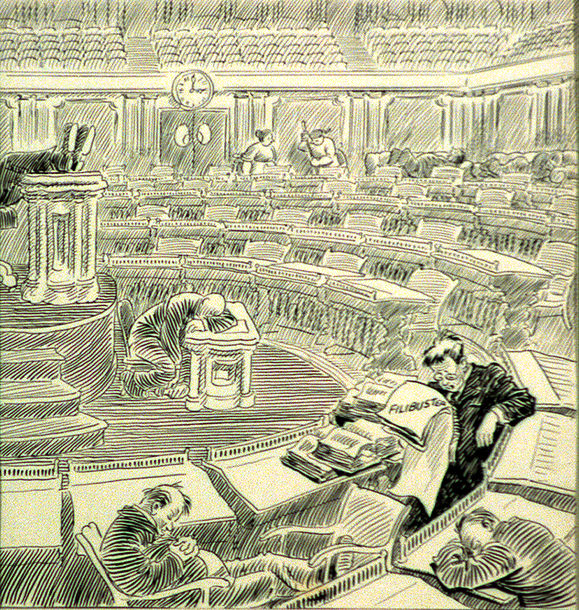
Saturday’s New York Times features a thought-provoking argument by Jamelle Bouie about removing the filibuster in the United States Senate. It is an argument that our nation has been hearing and pondering for decades.
The current rules of the Senate make productivity impossible. As long as the filibuster exists, Democrats will be bogged down in endless negotiations to try to win the minimum of four votes necessary to invoke cloture. Worse, the 60-vote threshold gives every Democrat leverage over the entire agenda. If, for example, John Fetterman does not want to pass a new Voting Rights Act, then a new Voting Rights Act will not get passed. Looking at the Senate landscape, it is hard to see where Democrats would pick up additional support. At no point in the last 20 years have Republicans shown any desire to work with Democrats to pass the party’s priorities.
The filibuster impedes bipartisanship by killing most legislation; why work together when there’s almost no chance that the bill will pass? And Democrats should understand by now that the filibuster does far more to impede their program than it does the Republican agenda, which rests almost entirely on items — tax cuts and judicial confirmations — that can be accomplished with a simple majority vote.
The American people elected Democrats to hold Trump accountable for corruption and despotism, and to govern. Congressional Democrats can do the former of their own accord. But to have any hope for the latter, Senate Democrats need to end, or at least amend, the filibuster. Anything less would squander the opportunity they’ve been given by voters.
While I understand that many of my progressive friends align with such a move, I differ; I would argue that the Senate should reform the filibuster, not destroy it. I don’t need to say that few institutional traditions in American politics inspire more frustration than the filibuster. I agree, as Boule implied, that the modern filibuster bears little resemblance to the dramatic “Mr. Smith Goes to Washington” image of senators speaking for hours on the chamber floor. Today, it often functions as a procedural weapon deployed routinely and with little public accountability.
Yet abolishing the filibuster altogether would be a profound mistake. One concern I have, especially when listening to young, energized partisans, is that there seems to be no recognition of why the filibuster exists in the first place. The Senate was never intended to operate like the House of Representatives. The Framers created two legislative chambers with different purposes. The House would respond quickly to public passions and shifting political winds. The Senate, with longer terms and equal representation for every state, would serve as a stabilizing force, encouraging deliberation, compromise, and caution. While the Constitution does not explicitly require a 60-vote threshold for ordinary legislation, the filibuster has evolved into one of the few remaining mechanisms that forces the majority party to consider minority viewpoints.
The point I would have the Blue-Wave riders think about is not sexy, but so very true. The strongest argument for preserving the filibuster is not what it does when your party is in power. It is what it does when your party loses power. History has a habit of humbling political movements that assume their majorities will last forever.
The history of recent Senate rule changes offers a cautionary tale. Both parties have weakened filibuster protections for nominations when it suited their immediate interests. Each side celebrated its victory. Each side later regretted empowering its opponents. Political leaders often discover that procedural weapons created for today’s battle become tomorrow’s headache.
I would argue that abolishing the filibuster would not reduce polarization. It would likely intensify it. When a bare majority can enact its entire agenda without negotiating, compromise becomes unnecessary, and moderation becomes politically costly. The incentive shifts from persuasion to conquest. That is just too risky, at a time when the very fabric of our democracy is so frayed, and there are elements who wish to shred it entirely. What I ask of those who wish to upend the filibuster is to think about what will happen when they wish that the guardrail they dismantled were still standing.


Leave a Reply